
Passive House Savings Calculator
If you plan to build a house and wonder whether the additional costs of making it energy-efficient are worth it in the long term, this passive house savings calculator might just be the tool for you. It will help you choose between a regular building, an energy-efficient house, and a passive house project. Read on if you want to learn how to calculate the prospective savings, what the differences are between passive and energy-efficient homes, and how to ensure maximum sustainability of your building.
🙋 If you're into understanding how to calculate the electricity cost of your house, our electricity cost calculator or our electricity cost - single usage calculator is for you.
Energy-efficient house vs passive house
You probably heard a lot of various terms like green buildings, sustainable buildings, or passive houses. The main differences between them are:
- An energy-efficient house is a building that uses less energy than specified in the standards. For example, in Germany, such a building has an energy use of less than 50 kWh/m² per annum.
- A passive house is a building with extremely low energy use, not exceeding 15 kWh/m² per annum. A conventional heating system is not needed in such buildings.
- A zero energy house has a net balance of energy equal to zero. It doesn't mean that it doesn't require energy at all, but the energy such a building takes from the power grid is equal to the energy supplied to it.
- An energy plus house generates a surplus of energy during a year.
You might also be considering installing solar panels on your house but don't know where to start. Don't worry because our solar panel calculator can help you with that. 😊
How to calculate passive house savings
- Start with the parameters of your house. Determine the total area of your house and how much it cost to construction (per square meter).
- Check with your local gas supplier how much it costs to heat your house. Type the price of gas per cubic meter into the calculator.
- Determine any additional costs required to make your house energy-efficient or passive. By default, these values are set to 9% and 15%, respectively, but you can change them at your will.
- Let our passive house savings calculator do the rest for you. It will return how long it will take for your investment to be returned.
- You can also use the
further attributes sectionsto customize values such as:
- How much energy is supplied from one cubic meter of gas?
- What is the annual energy demand of a regular house?
- What is the annual energy demand of an energy-efficient or a passive house?
💡 Find out how much you could also save with your car by understanding its fuel consumption with the use of our fuel cost calculator or our fuel mileage calculator.
Passive house characteristics
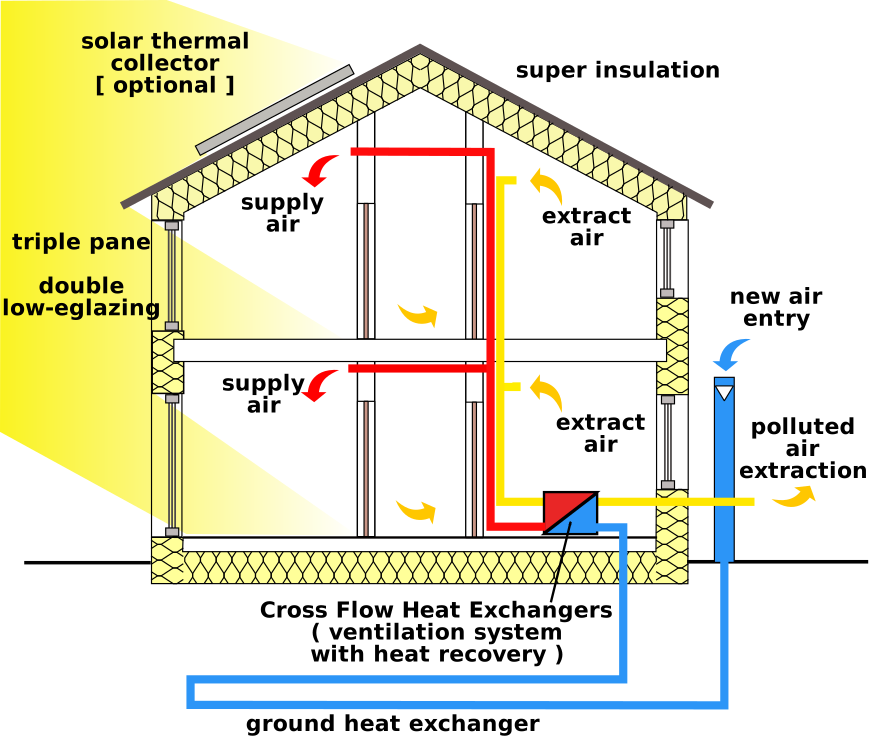
Some sample features of a green building are listed below:
- Passive houses tend to have compact structures - this means that the ratio of the area of external partitions to the volume of the house is as small as possible. What this means is the structure minimizes heat loss through partitions.
- Transparent partitions (windows) are used mostly on the southern side (in the northern hemisphere), where the heat gains and light from the sun are highest. No windows are placed on the northern elevation. Swap the directions if you are reading from the southern hemisphere.
- Special windows and doors with very low heat transmittance are used. It minimizes the losses of heat through such openings.
- Sustainable energy sources, such as solar panels, tend to be used. It is also popular to install heat pumps and recuperators.
- Special insulation materials are used to reduce the heat transfer through the walls to a minimum. If typical materials are used, the insulation is substantially thicker than in regular houses.
- Energy-efficient houses are built to maximize the proportion of natural light in lighting. At nighttime, low-energy lighting such as LED lamps are used.
FAQs
- What does the Passive House Savings Calculator do?
- Use our passive house savings calculator to determine how many years it will take for the money you invested in a passive house to be returned to you. Use the calculator above for instant results in your browser.
- Is the Passive House Savings Calculator free to use?
- Yes. All Try To Calculator tools are free and do not require an account.
- Are my inputs stored or sent to a server?
- No. Calculations run locally in your browser. We do not collect the numbers you enter or the results shown.
- Can I use the Passive House Savings Calculator for professional decisions?
- This tool is for education and quick estimates. For medical, legal, tax, or financial decisions, verify results with a qualified professional.
- Where can I find related calculators?
- Browse more Ecology tools on Try To Calculator at /ecology, or use the related calculators section on this page.
Related calculators
Plastic footprint
Find out how much plastic you use throughout the year with this plastic footprint calculator. Rethink your habits, reduce your plastic waste, and make your life
Ecology
Wind turbine
The wind turbine calculator finds the power output, efficiency, RPM, torque, and revenue of a wind turbine (either HAVT or VAWT).
Ecology
Shannon diversity index
The Shannon diversity index calculator provides a metric for assessing species diversity.
Ecology
Solar panel
Use our solar panel calculator to find your solar power needs and what panel size would meet them.
Ecology