MPC Calculator
The MPC calculator is a simple tool designed to compute the marginal propensity to consume, a fraction strongly linked to a concept of marginal propensity to save, average propensity to consume, or the money multiplier.
In the following, you can learn how to calculate MPC with the simple MPC formula and familiarize yourself with its importance in economics. Besides, you can also get familiar with the consumption function that you can also generate with the provided data.
If you would like to learn about elasticities, check our price elasticity of demand calculator or income elasticity of demand calculator, which are both essential concepts in microeconomics.
What is the marginal propensity to consume (MPC)? - The consumption function
In short, the marginal propensity to consume (MPC) is the amount by which consumption changes when disposable income increases by one dollar.
It is easy to see that the MPC is always between zero and one: an additional dollar of income increases consumption somewhere between nothing and one dollar. In other words, when households gain an extra dollar of income, they don't spend all that money but save a portion of it. For example, if the MPC is 0.8, then households spend 80 cents of each additional dollar of disposable income on consumer goods and services and save 20 cents.
We can represent the consumption - disposable income relation or the consumption function in a linear graph which is illustrated below. The slope of the consumption function shows how an individual household's consumer spending varies with the household's current disposable income. That is, the slope of the consumption function is the MPC.
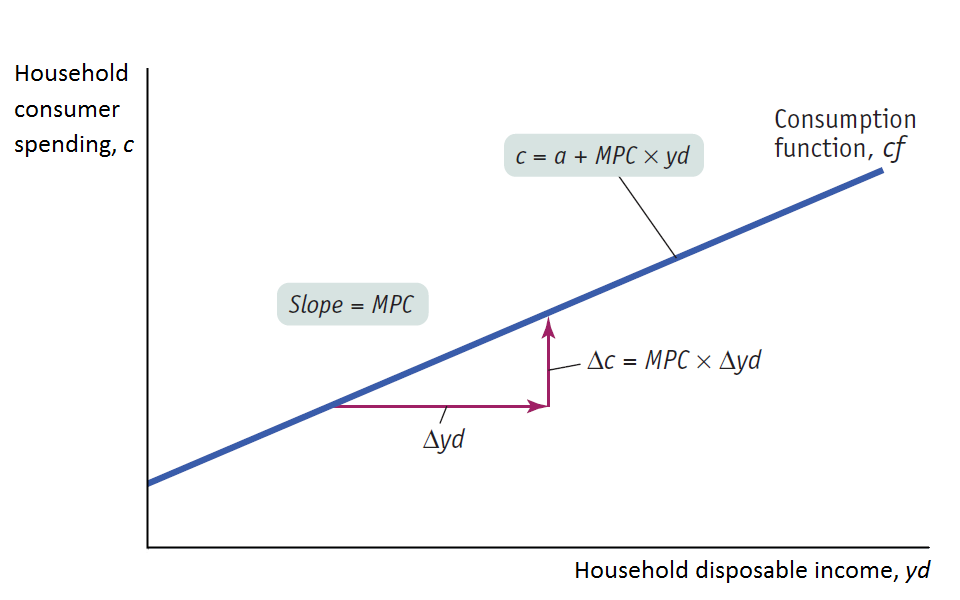
You may have noticed that the intercept of the blue line is not zero. Since households presumably would spend some money on essential needs financed by loans or savings even when they don't have income, consumer spending is positive when the disposable income is zero.
Marginal propensity to consume formula - How to calculate MPC?
Our MPC calculator, based on the definition of the MPC and the consumption function, incorporates the following two MPC formulae:
MPC = Δc / Δyd
and
c = a + MPC × yd
where,
Δc- increase in consumer spending;Δyd- increase in disposable income;c- consumer spending;a- autonomous consumer spending; andyd- disposable income.
In the MPC calculator, you can compute the MPC if you provide the increases in disposable income and consumer spending. By setting the autonomous consumer spending, you can define the consumption function, which appears below the result of the marginal propensity to consume.
Macroeconomic implication of the MPC - The aggregate consumption function
It is evident that people with high disposable incomes usually drive more expensive cars and live in more expensive houses with more money spent on their daily products. Empirical analyses suggest, however, the consumption function holds across the economy as a whole. In other words, there is a clear relationship between total disposable income and aggregate consumer spending, ascribed as the aggregate consumption function.
Since a considerable part of the Gross Domestic Product (GDP) is consumer spending, increasing disposable income on a larger scale, and therefore the fraction of it spent is very important in managing the economy.
It is particularly relevant in economic downturns when output or GDP is shrinking and the unemployment rate is rising. In such a situation, during the Great Recession or the COVID-19 crisis, for example, people, in general, have less disposable income.
Governments can possibly affect disposable income and thus stimulate spending through government transfers, such as the $600 unemployment benefit introduced in the coronavirus crisis. The value of the MPC becomes particularly crucial here: the higher the MPC, the more of this money transfer makes its way to businesses, which, through the multiplier effect, can significantly support economic recovery and generate GDP growth.
FAQs
- What does the MPC Calculator do?
- The MPC calculator lets you compute the value of the marginal propensity to consume and shows you the corresponding consumption function. Use the calculator above for instant results in your browser.
- Is the MPC Calculator free to use?
- Yes. All Try To Calculator tools are free and do not require an account.
- Are my inputs stored or sent to a server?
- No. Calculations run locally in your browser. We do not collect the numbers you enter or the results shown.
- Can I use the MPC Calculator for professional decisions?
- This tool is for education and quick estimates. For medical, legal, tax, or financial decisions, verify results with a qualified professional.
- Where can I find related calculators?
- Browse more Finance tools on Try To Calculator at /finance, or use the related calculators section on this page.
Based on 1 source
- Economics, Fifth Edition — Krugman, P.; Wells R.
Related calculators
Margin
Use the online margin calculator to find out the sale price, the cost or the margin percentage itself.
Finance
Discount
The discount calculator uses a product's original price and discount percentage to find the final price and the amount you save.
Finance
Markup
Markup calculator is a tool for sales people most often used to calculate the price you should charge.
Finance
Salary to hourly
Find your hourly wage instantly with our Salary to Hourly Calculator. Ideal for job seekers and employees to convert annual, monthly, or weekly salaries.
Finance