
PECARN Calculator
Our PECARN calculator for pediatric head injury computes the risk of a traumatic brain injury that may have a critical impact on a child's life or health. The PECARN rule is also used for assessing the need for a Computer Tomography (CT) scan. 💻
In the article below, we'll cover the essential aspects of the PECARN head trauma algorithm and discuss all the patient's evaluation's important details.
We try our best to make our s as precise and reliable as possible. However, this tool can never replace a professional doctor's assessment. If any health condition bothers you, consult a physician.
What are the PECARN criteria for a head injury?
PECARN stands for the Pediatric Emergency Care Applied Research Network - the first multi-institutional network funded by the US federal government.
Pediatric physiology and treatment are substantially different to adults when it comes to regular medical practice. Since we cannot directly transfer the studies on adults to clinical situations in children, a new approach was very much anticipated.
The PECARN algorithms were created in order to emphasize different standards of care for underage patients.
PECARN and head CT 🍩
Every pediatrician's job is based on a careful evaluation of a risk & benefit ratio. The need for Computer Tomography (CT) evaluation constitutes a big chunk of these considerations.
CT itself is extremely beneficial, but at the same time, an incredibly harmful source of clinical knowledge - one CT scan is equivalent to 200 regular chest X-rays. A major Dutch study has proven that exposure to CT in early childhood increases the risk of developing cancer by even 47%! No wonder why we carefully check whether it's really needed. Our PECARN head injury tool evaluates the possibility of clinically significant damage to the brain; a damage that outweighs the possible consequences of exposure to CT radiation.
❗ Our PECARN calculator shouldn't be used as a single source of knowledge; this tool cannot replace professional clinical judgment.
PECARN isn't the only tool used in pediatric emergencies - would you like to discover more?
Try the pediatric blood transfusion volume and the pediatric glomerular filtration rate calculator!
How to correctly use the PECARN calculator?
You only need to answer a maximum of 3 questions to obtain your results. The next question will appear after you have answered the previous one.
All the signs enumerated below are crucial for the correct assessment of all PECARN criteria.
1. Observe your patient. Note the following:
- Glasgow Coma Scale
- Any "cracking" sound or abnormal movement during palpation of the skull that may indicate a fraction
- Signs of basilar skull fracture: 💀
- Bruising of the mastoid part of the temporal bone (Battle sign);
- Raccoon eyes;
- Fluid coming out of the patient's nostril or ears; or
- Bleeding in the inner ear (visible through the tympanic membrane).
- Signs of AMS (Altered Mental State)
- Agitation;
- Somnolence (sleepiness);
- Slow response; and
- Repetitive questions.
- Any visible hematomas
2. Take a detailed history. Note the following:
- Loss of consciousness (note exactly how long it lasted)
- Episode of severe headache
- Episode of vomiting or severe nausea
- Injury mechanism - pay attention to:
- Motorized vehicle accidents involving a pedestrian or a cyclist;
- Accidents that took the life of another passenger;
- Rollover;
- Ejection from the vehicle;
- Fall from >3 ft or >1 m; and
- High-impact head struck (e.g., baseball).
3. Ask parents for their thoughts on their child's current behavior
- The child's guardians should quickly recognize a significant shift in their children's mental state and behavior.
You already know what to look for when assessing a head injury in children - now it's time to become a pediatric dosage master ⤵️
Discover the pediatric dose calculator or the Amoxicillin pediatric dosage calculator.
PECARN score algorithm
Our PECARN score calculator uses the following algorithm:
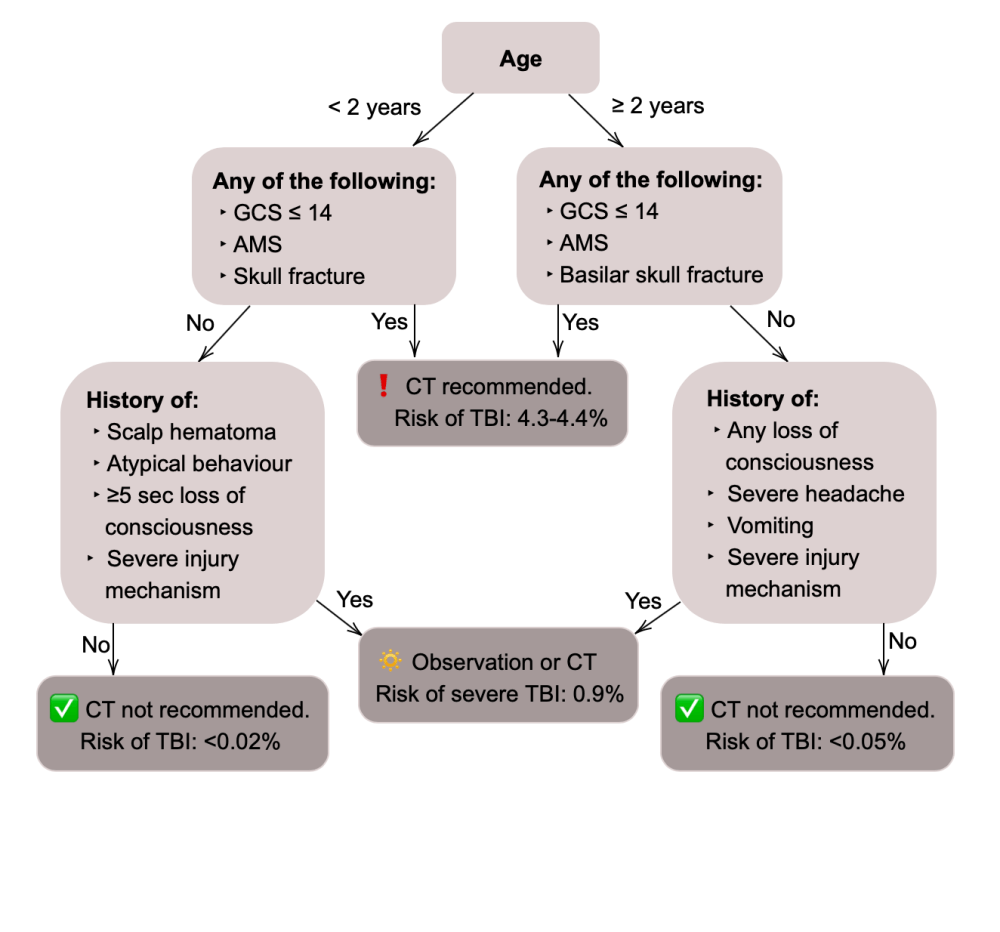
The abbreviation used in our tool for PECARN in pediatrics:
- AMS - Altered Mental State;
- TBI - severe Traumatic Brain Injury (with possible clinical consequences);
- GCS - Glasgow Coma Scale; and
- CT - Computer Tomography.
FAQs
- What does the PECARN Calculator do?
- PECARN calculator for children estimates the risk of Traumatic Brain Injury and the need for performing a Computer Tomography (CT) scan. Use the calculator above for instant results in your browser.
- Is the PECARN Calculator free to use?
- Yes. All Try To Calculator tools are free and do not require an account.
- Are my inputs stored or sent to a server?
- No. Calculations run locally in your browser. We do not collect the numbers you enter or the results shown.
- Can I use the PECARN Calculator for professional decisions?
- This tool is for education and quick estimates. For medical, legal, tax, or financial decisions, verify results with a qualified professional.
- Where can I find related calculators?
- Browse more Health tools on Try To Calculator at /health, or use the related calculators section on this page.
Based on 2 sources
- Identification of children at very low risk of clinically-important brain injuries after head trauma: a prospective cohort study — Nathan Kuppermann, James F Holmes, Peter S Dayan et al.
- Radiation Exposure From Pediatric CT Scans and Subsequent Cancer Risk in the Netherlands — Johanna M Meulepas, Cécile M Ronckers, Anne M J B Smets, Rutger A J Nievelstein, Patrycja Gradowska, Choonsik Lee, Andreas Jahnen, Marcel van Straten, Marie-Claire Y de Wit, Bernard Zonnenberg, Willemijn M Klein, Johannes H Merks, Otto Visser, Flora E van Leeuwen, Michael Hauptmann
Related calculators
Vaccine queue UK
The vaccine queue calculator for the UK estimates where you are in the queue to get your COVID vaccine based on your age, health, and job.
Health
Body shape
The body shape calculator determines your body type based on bust, waist, and hip measurements.
Health
Height
This height calculator predicts a child's adult height through two distinct methods: the Khamis-Roche formula and the Mid-Parental Height formula.
Health
BMR - Harris-Benedict equation
Harris-Benedict calculator uses one of the three most popular BMR formulas. Knowing your BMR (basal metabolic weight) may help you make important decisions abou
Health