
Social Distancing Calculator - Coronavirus
On 11th March 2020, the World Health Organization (WHO) officially designated the spread of coronavirus (COVID-19) as a pandemic, a disease epidemic that had spread throughout the world. As Tedros Adhanom Ghebreyesus, the WHO's director-general, said, the word pandemic can cause unreasonable fear or unjustified acceptance of failure, suffering, and death. Still, we should treat it symbolically to raise public awareness of the approaching danger.
At the same time, WHO believes that although this is the first pandemic caused by a coronavirus, we may be able to control the outbreak before it's too late. How to do this? As Dr. Adhanom explains: "Find, isolate, test and treat every case, and trace every contact".
To check whether this approach is reasonable, we created the coronavirus social distancing calculator based on the results of recent scientific research on the feasibility of controlling the COVID-19 outbreak. Please, stay at home and save lives!

Brian Solis on Twitter - "Some heroes wear capes; others wear face masks."
COVID-19 symptoms
COVID-19 symptoms may appear 2 to 14 days after initial infection. That's why people who believe that they have the disease should have some level of restricted movement for two weeks. The typical symptoms are initially flu-like and usually include:
- Fever;
- Dry cough;
- Shortness of breath after about a week (20% of patients require hospital treatment).
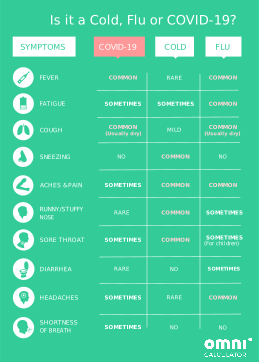
These symptoms can further develop into pneumonia (with chest tightness and chest pain). We rarely observe a runny nose, sneezing, or sore throat in a COVID-19 infection (only in 5% of cases). If you are exhibiting these symptoms, you likely have a cold. Symptoms in confirmed cases are usually mild (80% of cases), meaning that they can recover at home, while some are severe (13.8%), requiring hospitalization, critical (4.7%) requiring an intensive care unit (ICU), and even fatal (2%).
To make it easier to diagnose the illness, we summarized and compared the symptoms of COVID-19, flu, and cold in the picture below:
Should I be worried? - COVID-19 mortality rate
The pandemic of novel coronavirus remains a hot topic on both social and traditional media, and there can sometimes be two extreme camps:
- Negligence: we don't need to worry much; COVID-19 is another flu with a mortality rate of only 2 percent
- Panic: coronavirus outbreak is the biggest danger since the Spanish flu (which killed up to 100 million people), and may lead to the extinction of humanity;
Of course, both approaches don't reflect the real situation. Yes, COVID-19 is a new and dangerous flu that we can't neglect, but no, we won't all die.
The main problem with the coronavirus outbreak is that the reproduction number, R₀, (expected number of cases directly generated by one case) is large; recent studies on COVID-19 show that it could be between 1.4 and 3.8, or potentially even higher. Seasonal flu has an R₀ of 1.28. Therefore there is a risk that the number of sick people will snowball so quickly that healthcare services and infrastructure will run out of space for the newly infected.
Since the coronavirus incubation period can be between 2 & 14 days (5.1 days on average), infected people can spread the disease before they begin to show symptoms (some don't show any signs of infection for the entire duration of their infection). This fact, combined with a high reproduction number, makes it likely that the disease will spread to the whole world.
As of 3rd March, the WHO director-general stated that the mortality rate of COVID-19 is about 3.4% globally, compared to less than 1% for the seasonal flu. However, the fatality rate may change depending on the age group, sex, and pre-existing medical conditions of those infected. Among young, healthy women, some could be at risk due to early pregnancy, learn more about the first symptoms with the pregnancy test calculator and hCGlevels calculator. Remember that this mortality rate assumes that people receive proper medical assistance! Nobody knows how high it could be if hospitals become overwhelmed.
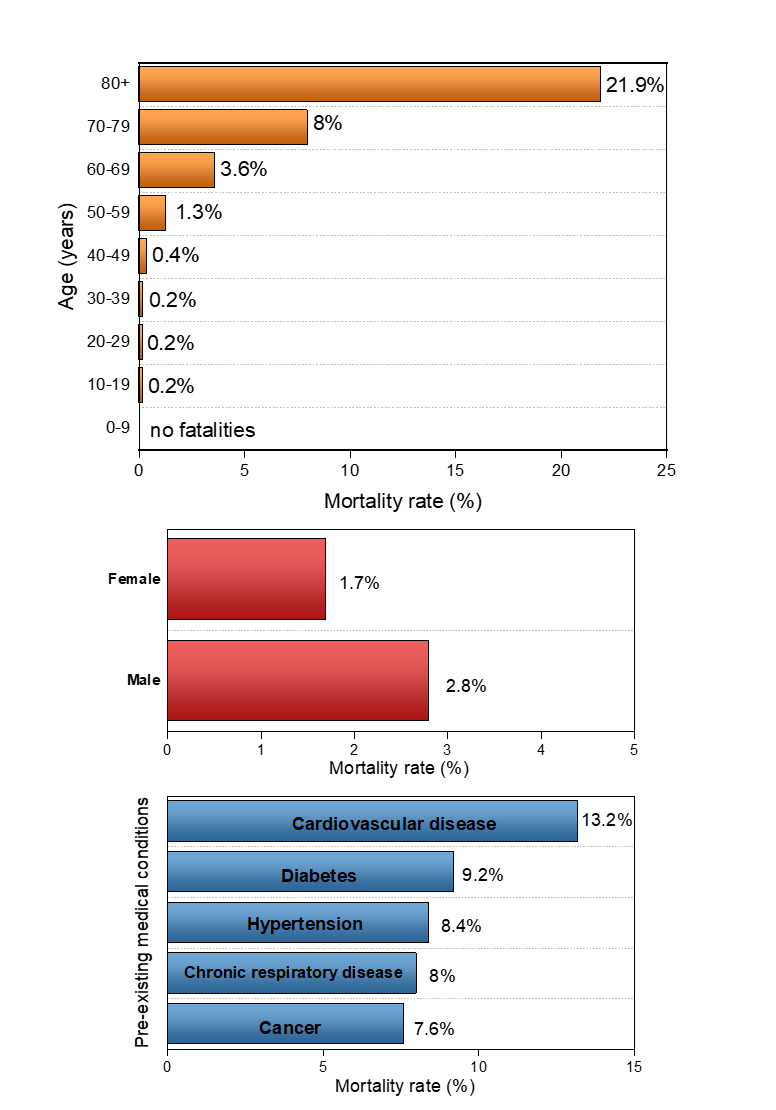
However, bear in mind that these mortality rates are calculated relative to confirmed cases of COVID-19. Nobody knows the total number of cases, because patients who have none or very mild symptoms may not be tested, and thus remain unidentified. In consequence, they are not taken into account when calculating the mortality rate.
How to prevent the spreading of the COVID-19?
So far, all strategies towards the containment of COVID-19 have only slowed the spreading of the virus. Meanwhile, many companies and academic institutions around the world are in constant pursuit of a vaccine to finally end the pandemic. They already have some promising candidates that are currently being tested on animals (and soon also on humans), but we probably won't get it until 2021, and even then, healthcare professionals will get it first.
So what can we do now? The Center for Disease Control and Prevention gives detailed instructions on How to Protect Yourself, and at the very beginning, we read that "The best way to prevent illness is to avoid being exposed to this virus". It sounds simple, but this is essential! A pandemic isn't the best time to travel or to meet friends outside. Instead, try to isolate yourself and stay at home any time it's possible.
Remember, you're responsible for not only your health but for that of the whole community. Living in isolation isn't easy (tens of millions of Chinese citizens have been in lockdown for over a month!), so prepare yourself by getting the books you always wanted to read or finally plan the project you've been procrastinating on for months. You could also start the new diet you always planned to (check our calorie deficit calculator and body fat calculator).
In their recent paper, Feasibility of controlling COVID-19 outbreaks by isolation of cases and contacts, scientists at the Centre for Mathematical Modelling of Infectious Diseases, at the London School of Hygiene & Tropical Medicine in the UK, found that the probability of controlling an outbreak drastically increases when we increase the amount of contact tracing and case isolation. As a result, we can reduce the effective reproduction number to less than one (R₀ < 1)!
It turns out that staying at home really does help! Use this social distancing calculator to explore their results and hopefully gain a better understanding of why staying at home is so important.
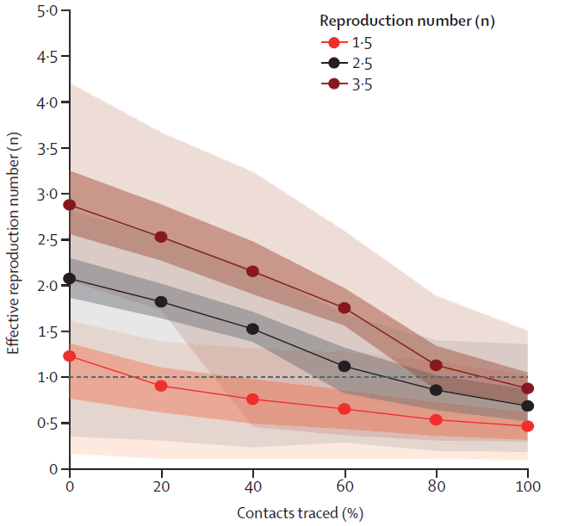
Picture from the Feasibility of controlling COVID-19 outbreaks by isolation of cases and contacts paper.
Useful links for COVID-19 protection and tracing
There are many available sources of information about COVID-19 pandemic. Here we provide you with a few we like the most:
- Centers for Disease Control and Prevention - guidelines for protection and steps to follow when you're sick.
- Coronavirus COVID-19 Global Cases Map by CSSE at JHU - an interactive map for cumulative confirmed and active cases of the COVID-19
- NY Times Coronavirus Map - the World, United States, Asia, and Europe coronavirus tracking maps
- Coronavirus Cases by Worldometer - comprehensive and updated statistics about the COVID-19
FAQs
- What does the Social Distancing Calculator do?
- Explore the probability of controlling the outbreak with our social distancing calculator - COVID-19. Use the calculator above for instant results in your browser.
- Is the Social Distancing Calculator free to use?
- Yes. All Try To Calculator tools are free and do not require an account.
- Are my inputs stored or sent to a server?
- No. Calculations run locally in your browser. We do not collect the numbers you enter or the results shown.
- Can I use the Social Distancing Calculator for professional decisions?
- This tool is for education and quick estimates. For medical, legal, tax, or financial decisions, verify results with a qualified professional.
- Where can I find related calculators?
- Browse more Health tools on Try To Calculator at /health, or use the related calculators section on this page.
Related calculators
Vaccine queue UK
The vaccine queue calculator for the UK estimates where you are in the queue to get your COVID vaccine based on your age, health, and job.
Health
Body shape
The body shape calculator determines your body type based on bust, waist, and hip measurements.
Health
Height
This height calculator predicts a child's adult height through two distinct methods: the Khamis-Roche formula and the Mid-Parental Height formula.
Health
BMR - Harris-Benedict equation
Harris-Benedict calculator uses one of the three most popular BMR formulas. Knowing your BMR (basal metabolic weight) may help you make important decisions abou
Health