
Error Function Calculator
Welcome to the error function calculator! It helps you compute the values of the four function from the erf family:
- Error function itself;
- Complementary error function;
- Inverse error function; and
- Inverse complementary error function.
If you are not sure what the Gaussian error function actually is, don't worry! If you scroll down, you will find all the necessary definitions and plots, as well as a short explanation of why the error function matters. As a bonus, we will show you how to (approximately) calculate erf by hand! Finally, at the very bottom of the page, you can find the error function table.
What is the error function?
The error function (often abbreviated to erf, also known as the Gaussian error function) is a special function that we encounter in applied mathematics and mathematical physics, e.g., in solutions to the heat equation.
For a real number x, the erf function is defined as
In the plot below, we see that erf is an odd sigmoid function.
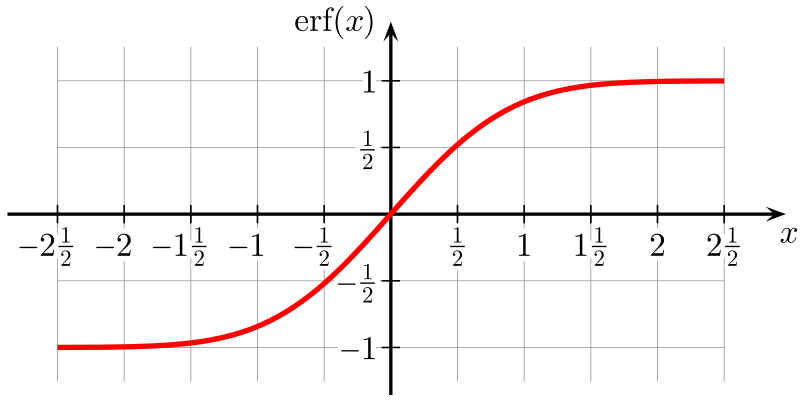
In statistics and probability theory, the error function has the following interpretation: for a random variable Z that follows the normal distribution with mean 0 and variance 0.5, the probability that Z falls in the interval [−x, x] is equal to erf(x), where we assume that x is non-negative. As a consequence, the error function is involved in many different calculations, in particular those you can encounter in the following tools:
Complementary error function
The complementary error function, most often denoted by erfc, is defined as one minus the error function. That is, we have
which we can also write as
In statistics, the complementary error function erfc(x), where we assume that x is non-negative, describes the probability that a random variable Z following the Gaussian normal distribution with mean 0 and variance 0.5 falls outside the interval [−x, x].
Inverse error function
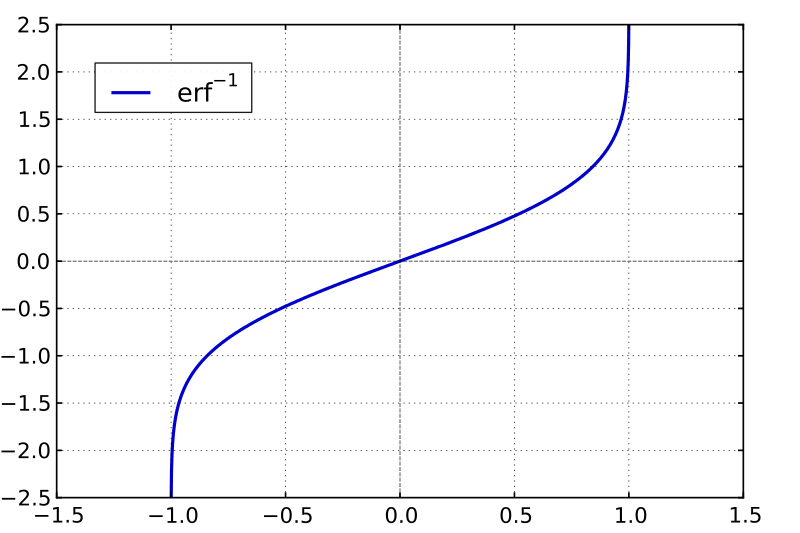
As we can see from the plot of the error function, if −1 < x < 1, then there exists a unique real number denoted erf-1(x), such that:
In this way we obtain the inverse error function. Below you can see its plot:
Finally, there is the inverse complementary error function erfc-1, which we define as
How to calculate erf using this error function calculator?
As the error function is a non-elementary function (as are the other three functions we defined above with the help of erf), it's not easy to find their values for a given argument x. Fortunately, erf calculator is here to help!
-
In the
modefield, choose which of the four functions from the erf family you want to calculate. -
Enter the value of the argument at which you want the function evaluated.
-
Our error function calculator returns the answer immediately. Enjoy!
How to calculate erf by hand?
What if one day you need to determine the Gaussian error function without a dedicated calculator at hand? Your situation isn't hopeless. There are several good ways of approximating erf. Let us mention two of them.
- The error function has the following Taylor (Maclaurin) series:
It holds for all real arguments x. In practical applications, you need to compute a partial sum of this series, i.e., the sum of several initial terms. The more, the better the approximation.
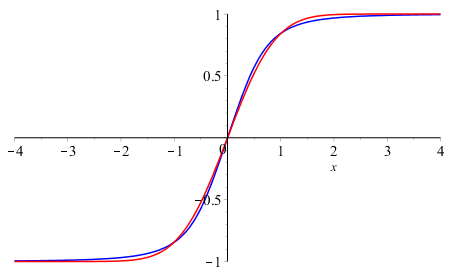
- It turns out that a suitably transformed cyclometric (inverse trigonometric) function,
arctan, can serve as a quite good approximation of the error function:
The plot below shows these two functions so that you can see how good the approximation is.
Error function table
Since erf is a special function and cannot be easily calculated without a dedicated calculator, there's been a long tradition of tabulating its values. In case you ever need such a table, we give it below. It covers the arguments between 0 and 3. For negative arguments you need to utilize the fact that erf is an odd function, i.e., that erf(-x) = -erf(x).
x | erf(x) | erfc(x) |
|---|---|---|
0 | 0 | 1 |
0.01 | 0.011283416 | 0.988716584 |
0.02 | 0.022564575 | 0.977435425 |
0.03 | 0.033841222 | 0.966158778 |
0.04 | 0.045111106 | 0.954888894 |
0.05 | 0.056371978 | 0.943628022 |
0.06 | 0.067621594 | 0.932378406 |
0.07 | 0.07885772 | 0.92114228 |
0.08 | 0.090078126 | 0.909921874 |
0.09 | 0.101280594 | 0.898719406 |
0.1 | 0.112462916 | 0.887537084 |
0.2 | 0.222702589 | 0.777297411 |
0.3 | 0.328626759 | 0.671373241 |
0.4 | 0.428392355 | 0.571607645 |
0.5 | 0.520499878 | 0.479500122 |
0.6 | 0.603856091 | 0.396143909 |
0.7 | 0.677801194 | 0.322198806 |
0.8 | 0.742100965 | 0.257899035 |
0.9 | 0.796908212 | 0.203091788 |
1 | 0.842700793 | 0.157299207 |
1.1 | 0.88020507 | 0.11979493 |
1.2 | 0.910313978 | 0.089686022 |
1.3 | 0.934007945 | 0.065992055 |
1.4 | 0.95228512 | 0.04771488 |
1.5 | 0.966105146 | 0.033894854 |
1.6 | 0.976348383 | 0.023651617 |
1.7 | 0.983790459 | 0.016209541 |
1.8 | 0.989090502 | 0.010909498 |
1.9 | 0.992790429 | 0.007209571 |
2 | 0.995322265 | 0.004677735 |
2.5 | 0.999593048 | 0.000406952 |
3 | 0.99997791 | 0.00002209 |
3.5 | 0.999999257 | 0.000000743 |
FAQs
- What does the Error Function Calculator do?
- Our error function calculator can determine the values of the error function, complementary error function, inverse error function, and inverse complementary error function. Use the calculator above for instant results in your browser.
- Is the Error Function Calculator free to use?
- Yes. All Try To Calculator tools are free and do not require an account.
- Are my inputs stored or sent to a server?
- No. Calculations run locally in your browser. We do not collect the numbers you enter or the results shown.
- Can I use the Error Function Calculator for professional decisions?
- This tool is for education and quick estimates. For medical, legal, tax, or financial decisions, verify results with a qualified professional.
- Where can I find related calculators?
- Browse more Math tools on Try To Calculator at /math, or use the related calculators section on this page.
Related calculators
Remainder
Use the remainder calculator to find the quotient and remainder of division.
Math
Slope
Calculate the slope of a line from two given points using the slope calculator. Discover the slope formula and learn how to find a slope with two points.
Math
Average
Calculate the average (mean) with our user-friendly tool. Discover how to find averages or perform quick calculations effortlessly.
Math
Circumference
Use this free circumference calculator to find the area, circumference and diameter of a circle.
Math