
Ratios of Directed Line Segments Calculator
The ratios of the directed line segments calculator will help you calculate the coordinates of the point that partition the line segment in a given proportion. This article will explore what a directed line segment is, how to partition a line segment with a given ratio with some examples, segment partition formula, and frequently asked questions.
If you're partitioning your line segment into two halves, our midpoint calculator will serve you equally well.
What is a directed line segment?
A line segment ABAB is a part of a line bound by two endpoints AA and BB where A=BA=B. A directed line segment ABAB is a line segment with a definite direction – it is the line segment directed from AA to BB.
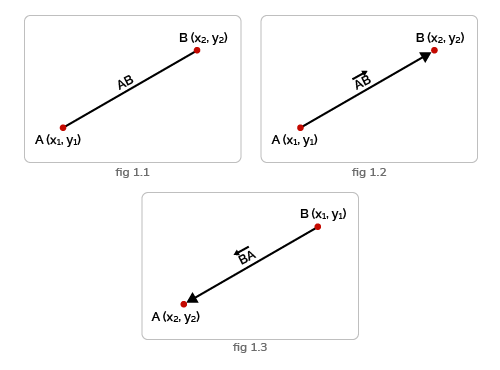
While the line segment ABAB can also be written as BABA, the same is not true for the directed line segment ABAB. This is because ABAB is directed from AA to BB, whereas BABA is directed from BB to AA.
🔎 Notice the similarities between a directed line segment and a vector? Not all directed line segments are vectors, but you can use a directed line segment to geometrically represent a vector with the same direction if the length of the line segment matches the magnitude of the vector. Our vector magnitude calculator can help you with this.
In the next section, we shall answer that burning question in your mind: how do you divide a segment into given ratios?
Directed line segment partitioning and formula
A point PP lying on the directed line segment ABAB will divide into two line segments. There are two ways to divide a line segment:
- Internally, when the point PP lies somewhere within the segment ABAB; and
- Externally, when the point PP lies somewhere on the extended line segment ABAB.
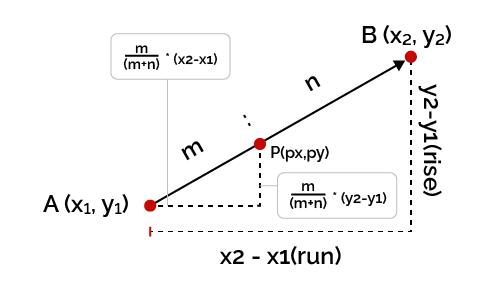
To partition the line segment ABAB internally into the ratio m:nm:n, the point P(px,py)P(px,py) must lie on ABAB such that it is m+nmm+nm away from AA and m+nnm+nn away from BB.
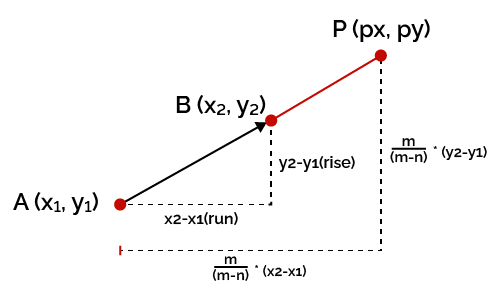
On the other hand, to partition the line segment ABAB externally into the ratio m:nm:n, the point P(px,py)P(px,py) must lie on the extended line segment ABAB such that it is m−nmm−nm away from AA and m−nnm−nn away from BB.
Now that you know the concept of breaking a line segment into a ratio let's put together a formula for a directed line segment divided by any point PP.
For the internal partition of ABAB:
And for the external partition of ABAB:
where:
- PP – Any point that partitions the directed line segment ABAB;
- px,pypx,py – The x- and y-coordinates of the point PP;
- m,nm,n – Ratio m:nm:n into which the point PP divides ABAB;
- x1,y1x1,y1 – The x- and y-coordinates of the endpoint AA of ABAB; and
- x2,y2x2,y2 – The x- and y-coordinates of the endpoint BB of ABAB.
❗ Keep in mind that in case of external division of the line segment, the ratios mm and nn cannot be equal and must be distinct to avoid a division by zero in the formula.
Now that you know the ratio of line segments formula, let's discuss it further, along with some examples of segment partition calculation.
How do I partition a line segment with a given ratio?
To find the point P(px, py) that internally divides the line segment AB into the ratio m:n, follow these steps:
- Calculate px using px = (mx2 + nx1)/(m + n), where x1 and x2 are the x-coordinates of A and B respectively.
- Determine py using py = (my2 + ny1)/(m + n), where y1 and y2 are the y-coordinates of A and B respectively.
To find the point P(px, py) that externally divides the line segment AB into the ratio m:n, follow these steps:
- Compute px using px = (mx2 - nx1)/(m - n), where x1 and x2 are the x-coordinates of A and B respectively.
- Find py using py = (my2 - ny1)/(m - n), where y1 and y2 are the y-coordinates of A and B respectively.
For example, consider a line segment ABAB with the endpoints A(1,2)A(1,2) and B(4,6)B(4,6). The direction of this segment would be from AA to BB. To find a point that divides this segment internally in the ratio 2:32:3, we can use the internal partition formula as follows:
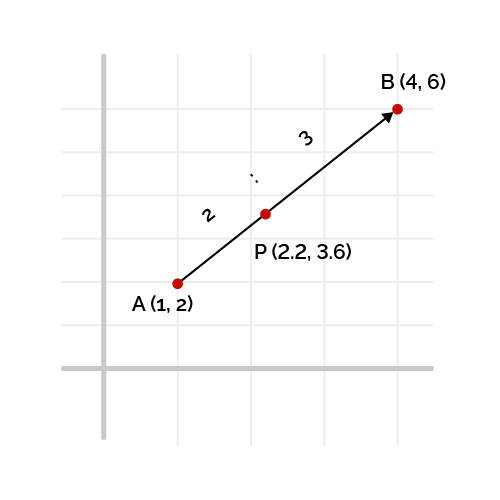
Note that to say that the point P(2.2,3.6)P(2.2,3.6) divides ABAB in the ratio 2:32:3 is the same as saying that the point P(2.2,3.6)P(2.2,3.6) lies 52th52th away from the endpoint A(1,2)A(1,2) and 53th53th away from the endpoint B(4,6)B(4,6).
Now, if we want to divide the same line segment externally in the same ratio, then we shall employ the formula for external partition of the line segment:
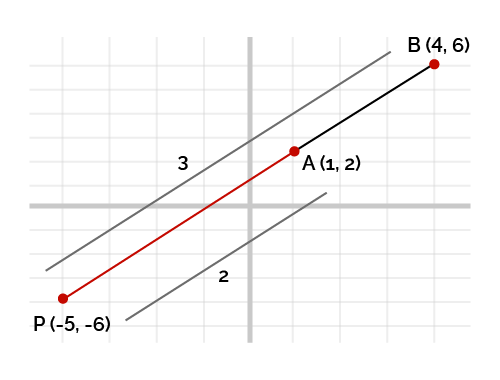
See how easy it is to partition a line segment in a given ratio?😉 Go ahead and try some practice problems and master this method! You can always verify your results using this calculator to divide line segments.
How to use this ratios of directed line segments calculator
This ratios of directed line segments calculator is beneficial to find the point that divides a directed line segment in a given ratio or to find the ratio in which a given point splits the line segment.
-
Choose the type of partition between internal and external in the The line is partitioned... field. By default, we set it as an internal partition.
-
Enter the coordinates of the endpoints of the segment. Ensure that you're getting the direction of the line segment correct. In this calculator, the direction is always from A(x1,y1)A(x1,y1) to B(x2,y2)B(x2,y2).
-
This step depends on whether you want to find the point or the ratio:
- If the ratio is the given value, enter the given ratio in the corresponding fields, and the coordinates of the point appear in their respective fields, along with a helpful graph. Otherwise, leave the ratio fields empty.
- If the coordinates of the point are the given value, enter these coordinates in the corresponding fields, and the resulting ratio will appear at the bottom.
You now have a simple tool to help you calculate the partitioning of a line segment anytime you need it! Also check out our Golden ratio calculator or Endpoint calculator for more line segment partition calculations.
FAQs
- How do I partition a line segment with a given ratio?
- To find the point P(px, py) that internally divides the line segment AB into the ratio m:n, follow these steps: Calculate px using px = (mx2 + nx1)/(m + n), where x1 and x2 are the x-coordinates of A and B respectively. Determine py using py = (my2 + ny1)/(m + n), where y1 and y2 are the y-coordinates of A and B respectively. To find the point P(px, py) that externally divides the line segment AB into the ratio m:n, follow these steps: Compute px using px = (mx2 - nx1)/(m - n), where x1 and x2 are the x-coordinates of A and B respectively. Find py using py = (my2 - ny1)/(m - n), where y1 and y2 are the y-coordinates of A and B respectively.
- How do I find a point that divides a segment in half?
- If you know the coordinates of the endpoints of the line segment, you can easily find its mid-point (xm, ym) using these steps: Calculate the average of the x-coordinates of the end-points to get the x-coordinate of the mid-point. xm = (x1 + x2)/2. Determine the average of the y-coordinates of the end-points to obtain the y-coordinate of the mid-point. ym = (y1 + y2)/2. Verify these results using our Midpoint Calculator or Ratios of Directed Line Segments Calculator.
- How can I divide a line segment into three equal parts?
- To divide a line segment AB into three equal parts, you need to find two points P(px, py) and Q(Qx, Qy) on AB, such that they each divide AB into the ratios 1:2 and 2:1: Calculate the x-coordinate px of the point P using the formula px = (2x2 + x1)/3, where x1 and x2 are the x-coordinates of A and B respectively. Compute the y-coordinate py of the point P using py = (2y2 + y1)/3, where y1 and y2 are the y-coordinates of A and B respectively. Determine the x-coordinate qx of the point Q using qx = (x2 + 2x1)/3. Find the y-coordinate qy of the point Q using qy = (y2 + 2y1)/3. Put these coordinates together to get the points P(px, py) and Q(qx, qy).
- How to find a point lying one-third of the way from an endpoint?
- A point P lying one-third of the way from the endpoint A on the line segment AB will divide it in the ratio 1:2. To find this point, follow these simple steps: Calculate the x-coordinate px of this point using the formula px = (2x2 + x1)/3, where x1 and x2 are the x-coordinates of A and B respectively. Compute the y-coordinate py of this point using py = (2y2 + y1)/3, where y1 and y2 are the y-coordinates of A and B respectively. Put them together to obtain the desired point P(px, py).
Related calculators
Remainder
Use the remainder calculator to find the quotient and remainder of division.
Math
Slope
Calculate the slope of a line from two given points using the slope calculator. Discover the slope formula and learn how to find a slope with two points.
Math
Average
Calculate the average (mean) with our user-friendly tool. Discover how to find averages or perform quick calculations effortlessly.
Math
Circumference
Use this free circumference calculator to find the area, circumference and diameter of a circle.
Math