
Sinh Calculator
sinh calculator is here to help you deal with the hyperbolic sine function, which you may encounter in various areas of math and engineering. Scroll down to learn more about this important function (and a bit about other hyperbolic functions as well).
Topics range from really basic (what sinh x actually is and what are the basic sinh and cosh identities) to more slightly advanced (the inverse hyperbolic sine and the derivative of sinh).
As a bonus, we'll discuss how to put hyperbolic sine in a calculator (we mean a really basic calculator) should it ever happen you don't have access to and its hyperbolic sine calculator.
What is sinh x in math?
Sinh is a function in math called hyperbolic sine. It is defined as
But what does it have to do with sine? we hear you ask. To see the connection, we must introduce the twin of sinh, that is the cosh (also known as hyperbolic cosine), defined as
Now if we plot points with coordinates (coshxcoshx, sinhxsinhx) in the standard Cartesian coordinate system, we obtain a hyperbola, as you can see in the picture below. (More precisely, we'll obtain only the right-hand side part of the hyperbola.)
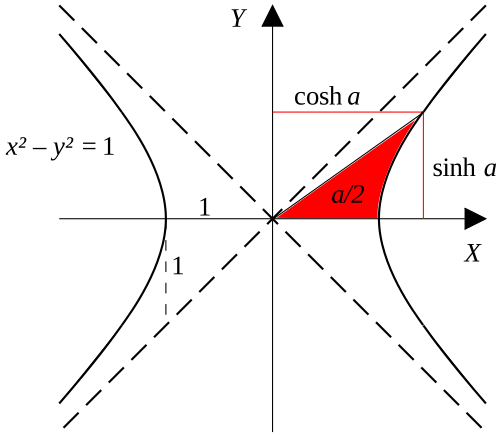
Recall that when we plot the points (cosxcosx, sinxsinx), they form a circle (the unit circle). And the similarities do not end here! It turns out our hyperbolic sine and hyperbolic cosine satisfy certain formulae that are very similar, or sometimes even identical, as those that we know for the good ol' (non-hyperbolic) sine and cosine. Namely, we have the double-angle formula
and
which is an analogue of the Pythagorean trigonometric identity cos2x+sin2x=1cos2x+sin2x=1.
Graph and properties of sinh
Let us plot the graph of the sinh function.

Looking at the plot, we can discover some properties of the hyperbolic sine:
- sinh is an odd function, i.e., sinh(−x)=−sinh(x)sinh(−x)=−sinh(x);
- sinh is increasing;
- sinh(0)=0sinh(0)=0;
- sinh is not periodic;
- sinh is not bounded; and
- sinh is a bijection, so it has an inverse.
So how can you calculate the inverse of sinh? Let's move on to the next section.
What is the inverse of hyperbolic sine?
The inverse function of sinh is denoted by arsinh. The formula for arsinh reads:
It involves logarithms, which is what we expected since the definition of sinh involves exponentials.
Be careful not to confuse the inverse function of sinh with the multiplicative inverse, that is, with the function mapping xx to 1/sinhx1/sinhx. This function has its own name: its called csch (Not a very intuitive name, we admit...):
if x=0x=0.
How to use this sinh calculator
hyperbolic sine calculator is very straightforward to use: just enter the argument x, and the value of sinh(x) will appear immediately!
And you can calculate inverse sinh as well! Just fill in the field sinh(x), and the value that appears as x is exactly the value of the inverse function.
And this is not all! If you expand the 'Other hyperbolic functions' section of the calculator, you'll be able to see the values of several other hyperbolic functions, in particular of the derivative of sinh — it hides under the name of cosh ;)
Since hyperbolic functions like to pop up in calculations related to various domains, it's important you familiarize yourself with them a bit! Once you're done with the sinh calculator, do not hesitate to visit the following tools:
FAQs
- How do I put hyperbolic sine in a calculator?
- To compute sinh(x) with a basic calculator: Make sure your calculator can perform exponentiation. If not, search for an online exponentiation calculator (or go straight to an online sinh calculator). Compute exp(x) and store the result (write it down or use the memory of your calculator). Compute exp(-x) and store the result. Compute exp(x) - exp(-x). Divide the result by 2. That's it; well done!
- What is the derivative of sinh?
- The derivative of sinh is cosh, that is, the hyperbolic cosine, defined as cosh(x) = (exp(x) + exp(-x))/2. You can easily remember this fact by recalling that this is exactly what happens with standard sine and cosine functions!
- How do I calculate sinh 1 given cosh 1?
- To compute sinh 1 given cosh 1 Use the cosh²x - sinh²x = 1 identity. It gives us the following: sinh²(1) = cosh²(1) − 1 Now you can perform a simple subtraction: sinh²(1) = 1.543² − 1 = 2.381 − 1 = 1.381 Then, take the square root of sinh²(1): sinh(1) = 1.175
Related calculators
Remainder
Use the remainder calculator to find the quotient and remainder of division.
Math
Slope
Calculate the slope of a line from two given points using the slope calculator. Discover the slope formula and learn how to find a slope with two points.
Math
Average
Calculate the average (mean) with our user-friendly tool. Discover how to find averages or perform quick calculations effortlessly.
Math
Circumference
Use this free circumference calculator to find the area, circumference and diameter of a circle.
Math