
Triangle Proportionality Theorem Calculator
If you're studying geometry, a triangle proportionality theorem calculator like this one can be of great help.
Apart from knowing what the triangle proportionality theorem is, you also need to be familiar with how to use it. With our tool, you'll learn how to find the length of the lines that make up the segments intersected by DE (look at the image).
If you want to dig deeper, we present the triangle proportionality theorem proof in the FAQ section.
What is the triangle proportionality theorem?
In geometry, the triangle proportionality theorem says:
💡 If a line parallel to one side of a triangle intersects the other two sides, then the line divides those two sides proportionally.
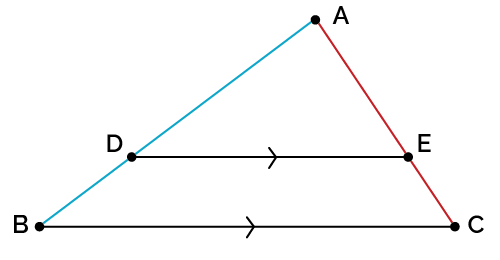
For example, for the triangle above, in which the line DE (parallel to the BC side) intersects the other two sides (AB and AC), the triangle proportionality theorem says:
You can draw lines across the three directions as long as they're parallel to one side, and the theorem will still be valid.
Now that you know the theory behind the calculation of the triangle proportionality theorem, you can look at other tools similar to this triangle proportionality theorem calculator.
Other tools similar to this triangle proportionality theorem calculator
FAQs
- What is a true statement about a 45-45-90 triangle?
- A true statement about a 45-45-90 triangle is that the hypotenuse length is √2 times the length of either leg. Let's explain why 👇 From the sine definition: sin(45°) = opposite/hypotenuse hypotenuse = (1/sin(45°)) × opposite hypotenuse = √2 × opposite As the opposite sides are the legs, and both sides are equal: hypotenuse = √2 × leg
- What is the converse of the triangle proportionality theorem?
- As for any theorem, we can state a converse for the triangle proportionality theorem: If a line divides two sides of a triangle proportionally, that line must be parallel to the third side.
- How do I prove the triangle proportionality theorem?
- To prove the triangle proportionality theorem, consider a triangle ABC with a line DE parallel to BC (image below) As parallel lines form congruent angles, then: ∠ADE ≅ ∠ABC and ∠AED ≅ ∠ACB From the AA similarity criteria: △ABC ~ △ADE As the triangles are proportional: AB/AD = AC/AE Using the denominator subtraction property: (AB - AD)/AD = (AC - AE)/AE As AB - AD = DB and AC - AE = EC, we can achieve the proof of the triangle proportionality theorem: DB/AD = EC/AE That's how you prove the triangle proportionality theorem!
Related calculators
Remainder
Use the remainder calculator to find the quotient and remainder of division.
Math
Slope
Calculate the slope of a line from two given points using the slope calculator. Discover the slope formula and learn how to find a slope with two points.
Math
Average
Calculate the average (mean) with our user-friendly tool. Discover how to find averages or perform quick calculations effortlessly.
Math
Circumference
Use this free circumference calculator to find the area, circumference and diameter of a circle.
Math