
Doppler Effect Calculator
The Doppler effect calculator will help you analyze the changing frequency of sound you hear if either the source of sound or the observer is in motion. This article will explain in detail what is the Doppler effect and how to properly use the Doppler effect equation.
What is the Doppler effect?
Imagine that you are standing on the sidewalk of a busy street. You can hear the siren of an ambulance approaching you. Once the ambulance passes you, the sound's pitch – in other words, its frequency – changes. The sound appears to be "lower" as its frequency decreases.
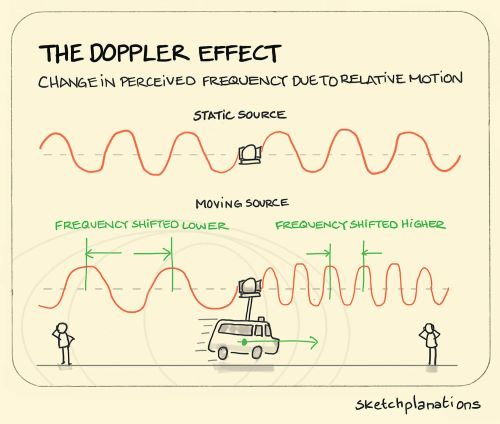
Why did that happen? Precisely because of the Doppler effect. Doppler hypothesized that if a source of waves moves relative to the observer, then the frequency of these waves changes (along with their wavelength). Learn more about waves in our wavelength calculator or our frequency calculator.
Doppler effect is widely used in medicine – it allows us to measure the blood flow in arteries and veins, perform ultrasound, and it also has a great purpose when dealing with how to calculate cardiac output with echocardiography doppler.
Doppler effect equation
The Doppler shift can be described by the following formula:
where:
- ff – Observed frequency of the wave, expressed in Hz.
- f0f0 – Frequency of the emitted wave, also expressed in Hz.
- vv – Velocity of the waves in the medium. By default, our Doppler effect calculator has this value set to
343.2 m/s, the speed of sound propagating in the air. For a more precise value, use our speed of sound calculator. - vrvr – Velocity of the receiver. It is positive if the receiver is moving toward the source; and
- vsvs – Velocity of the source. It is positive if the source is moving away from the observer.
Doppler shift – an example of calculations
Let's analyze a more complex example of the approaching ambulance. You are riding a bicycle along the road, going in the same direction as the ambulance. You can hear the siren of the ambulance behind you as the ambulance approaches you. What is the change in sound frequency after it passes you?
-
Determine the speed of both the ambulance and the bicycle. Let's assume that the ambulance travels at
60 km/hand the bike at15 km/h. -
Determine the sound frequency. Let's take
700 Hz. -
Decide on the signs of both velocities before the ambulance passes you: are they negative or positive? Ambulance velocity will be negative (as it moves towards you), and the bicycle velocity will be negative as well (because you move away from the source).
-
Calculate the observed frequency of sound before the ambulance moves past you using the Doppler shift formula. You can check in our Doppler effect calculator that the result will be equal to
727 Hz. -
Decide on the signs of both velocities after the ambulance passes you. Ambulance velocity will be positive (as it now moves away from you), and the bicycle velocity will be positive as well (because you move towards the source).
-
Calculate the observed frequency of sound after the ambulance moves past you. The result will be equal to
676 Hz. -
Finally, subtract one value from the other to find the change in frequency:
727 - 676 = 51 Hz.
If you are interested in sound Physics, also try the dB calculator.
FAQs
- What does the Doppler Effect Calculator do?
- Our Doppler effect calculator allows you to calculate the frequency of sound if either the source of sound or the observer is moving. Use the calculator above for instant results in your browser.
- Is the Doppler Effect Calculator free to use?
- Yes. All Try To Calculator tools are free and do not require an account.
- Are my inputs stored or sent to a server?
- No. Calculations run locally in your browser. We do not collect the numbers you enter or the results shown.
- Can I use the Doppler Effect Calculator for professional decisions?
- This tool is for education and quick estimates. For medical, legal, tax, or financial decisions, verify results with a qualified professional.
- Where can I find related calculators?
- Browse more Physics tools on Try To Calculator at /physics, or use the related calculators section on this page.
Related calculators
Acceleration
The acceleration calculator estimates acceleration using three different approaches – velocity difference, distance traveled over time, and net force vs. mass.
Physics
Density
Use the density calculator to instantly find how tightly packed an object's molecules are.
Physics
Free fall
Our free fall calculator can find the velocity of a falling object and the height it drops from.
Physics
Projectile motion
Use our projectile motion calculator to analyze a projectile in parabolic motion.
Physics