
Elongation Calculator
The elongation calculator will help you calculate the elongation of a material specimen under tension or compressive loads. Elongation is one of the fundamental concepts of material science as it relates to the length of an object before and after the loading condition. In simple terms, when you apply a load on any entity, its size changes. Depending on the type of load and material, it undergoes either elongation or compression.
Scientists and engineers study elongation for materials under different loading conditions to characterize their behavior. This data is helpful for designers during the process of material selection while designing components.
For example, if you want to create a beam for a tensile load of 50 kN, you will need the data on how much it would elongate under 50 kN and what is its fracture strain. Therefore it is essential to understand the meaning of elongation as the concept helps calculate other parameters like stress or strain, which are also crucial to any structural design. Check out our stress calculator for more information about stress.
The calculator accepts input for initial and final lengths to return the elongation in percent. Read on to understand what elongation is and how to calculate elongation in percent.
What is elongation – percent formula
The definition of elongation is the ratio of change in length and the original length. It is also common to call it the elongation percent. Thus, the natural unit of elongation is percent. Although the elongation is measured in percentage with respect to the original length, it is often mentioned with other units.
Consider a rod of length LoLo under tensile load along the longitudinal direction. Due to the nature of force, the rod's length would increase, and the area of the cross-section will decrease (learn more with our cross-sectional area calculator). Say the length of the rod under tensile load is LfLf. Then the change in length, ΔLΔL is:
The ratio of change in length, ΔLΔL to the original length LoLo is known as the engineering strain or the Cauchy strain (it is different from true strain – see our true strain calculator for more). The formula for elongation percent is:
If the elongation is negative, that means the final length is less than the original, i.e., the material has shrunk instead of expanding.
As the material stretches, it reaches a point beyond which it is no longer possible to stretch it. The material breaks at this point, known as the fracture strain or elongation at break. The fracture strain is a material property representing a material's ductility. The material is more ductile if the fracture strain value is higher.
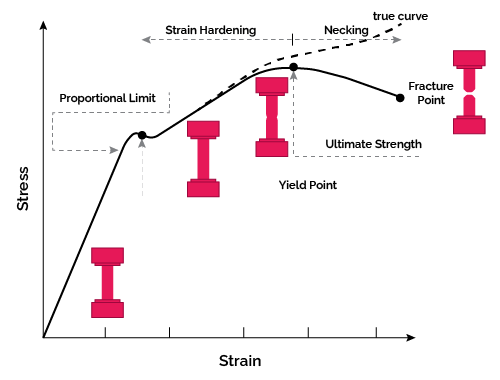
Fracture strain
You can select the material and use their fracture strain values to compare the elongation from your calculations to check for material failure.
How to calculate elongation – Using the elongation calculator
Now that we know the definition of elongation, let's calculate elongation for a polylactide (PLA) specimen whose initial and final lengths are 10 mm10 mm and 12 mm12 mm, respectively.
-
Select the material as polylactide (PLA).
-
The calculator will display the elongation at break (in %) as 5%5%.
-
Enter the original length as 10 mm10 mm.
-
Fill in the final length as 12 mm12 mm.
-
The elongation calculator will return the change in length and the elongation percent as:
The material specimen has elongated by 20%20%. However, since the polylactide (PLA) has a fracture strain of 5%5%, the material will break before that point and won't achieve the required elongation value.
FAQs
- What do you mean by elongation?
- Elongation is the process of stretching a material. It is also the ratio of change in length to the original length. The change in length is the difference between final and initial lengths.
- How do I calculate elongation?
- To calculate elongation: Find the original and final lengths of the material specimen. Subtract original length from final length to obtain change in length. Divide change in length by original length. Multiply the term by 100% to obtain the elongation for the specimen.
- What do you mean by elongation at break?
- As a material specimen elongates, it demonstrates elastic behavior before going beyond the yield point and ultimately breaks. The strain at which it fails is called the fracture strain or elongation at break.
- What is the elongation if the change in length is 5 mm for a 10 mm long object?
- The elongation is 50%. For a specimen initially having a length of 10 mm and a change in length of 5 mm, the final length is 15 mm. The elongation is 5/10 × 100% = 50%.
Related calculators
Acceleration
The acceleration calculator estimates acceleration using three different approaches – velocity difference, distance traveled over time, and net force vs. mass.
Physics
Density
Use the density calculator to instantly find how tightly packed an object's molecules are.
Physics
Free fall
Our free fall calculator can find the velocity of a falling object and the height it drops from.
Physics
Projectile motion
Use our projectile motion calculator to analyze a projectile in parabolic motion.
Physics