
Heat Transfer Coefficient Calculator
This heat transfer coefficient calculator will help you determine the overall heat transfer coefficient or film coefficient. This parameter is vital to most heat transfer calculations and insulation, especially for building walls. For instance, if a designer wishes to reduce the heat transfer via a building wall or heat exchanger, they add several layers of insulation.
This tool uses the heat transfer coefficient equation while giving you the option of adding up to 10 layers to your wall and returning the thermal resistance and overall heat transfer coefficient for the stacked structure.
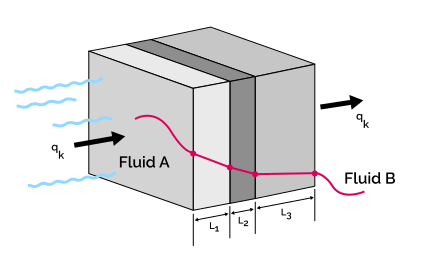
The heat transfer coefficient is a function of wall thickness, thermal conductivity, and the contact area of the wall. The tool considers free convection on either side of the wall while performing the calculations. Different types of convection and flow geometries also exist using the Nusselt number. Read on to understand what the heat transfer coefficient is and how to use the heat transfer coefficient formula.
🙋 If you are unsure about what thermal conductivity isor how to calculate it, you can look at thermal conductivity calculator to learn more about this topic!
Overall heat transfer coefficient — Concept of thermal resistance
What is heat transfer coefficient? — It is a measure of how well a wall or structure conducts heat. In other words, the ratio of heat transfer through unit area and temperature difference. This ratio is the combined value for all the layers in the structure. It is measured in W/m2KW/m2K or BTU/(h⋅∘F⋅ft2)BTU/(h⋅∘F⋅ft2). The heat transfer coefficient formula considering n layers in a structure is:
where:
- UtUt – Heat transfer coefficient;
A– Contact area;L– Thickness of nthnth layer; andk– Thermal conductivity of layer material.
Did you know?
The lower the value of heat transfer coefficient, the better the insulation provided by the structure and vice versa.
Concept of thermal resistance — It is the resistance of a material against heat flow or conductance. In other words, thermal resistance is the ratio of the temperature difference and heat conducted through a medium. It is analogous to Ohm's law, which is:
where:
- II – Current;
- V1−V2V1−V2 – Voltage difference; and
- ReRe – Resistance.
Here, the current is the rate of heat transfer, QQ, voltage difference being the temperature difference, T1−T2T1−T2. The electrical resistance corresponds to thermal resistance RtRt (check Ohm's law calculator). Therefore the thermal resistance equation becomes,
The units of thermal resistance are K/W or °C/W. You can also relate thermal resistance with the overall heat transfer coefficient as:
For several layers stacked one after another, the thermal resistance equation is:
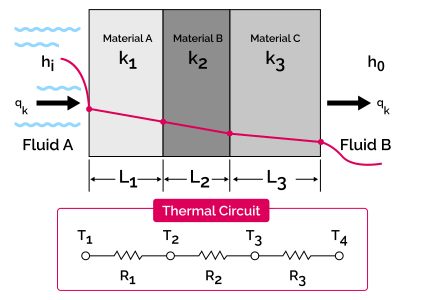
The above case applies to conduction-only. However, when the inner and outer surfaces of walls are exposed to air or any other fluids, another factor needs to be considered. In that case, the convective heat transfer coefficient hh is used to determine the convective resistance of the medium. Such that:
To find out the overall heat transfer coefficient, we add the convective resistance to the conductive resistance, RtRt:
where:
- hihi – Convective heat transfer coefficient of fluid, inner surface; and
- hoho – Convective heat transfer coefficient of fluid, outer surface.
The units of convective heat transfer coefficient are equal to those of the heat transfer coefficient, i.e., W/m2⋅KW/m2⋅K or BTU/(h⋅∘F⋅ft2)BTU/(h⋅∘F⋅ft2).
💡 If you'd like to read more about heat transfer calculations applied to heat exchangers, visit the LMTD calculator or the effectiveness NTU calculator.
How to calculate heat transfer coefficient or film coefficient
The calculator has two modes:
- Conduction only; and
- Conduction with convection on both sides.
In addition to this, it begins with a single layer of material, on which you can stack or remove layers.
To find the overall heat transfer coefficient and thermal resistance:
- Select the mode of heat transfer, say,
conduction only. - Enter the area of contact, AA.
- Insert the initial thickness of the wall, L0L0.
- Fill in the thermal conductivity of the wall material, k0k0.
- Add more layers by ticking the options below the "Add or remove layers" section.
- Repeat the steps
3and4for all layers. - The calculator gives thermal resistance and overall heat transfer coefficient as per the configuration.
Stacked walls
You can use this tool to find the heat transfer coefficient and thermal resistance for a structure by stacking up to 11 layers.
Example: Using the heat transfer coefficient calculator
Find the overall heat transfer coefficient of a window having 2 layers of 2 mm thick glass with a gap of 5 mm filled with air in between. Take contact area as 1.2 m21.2 m2. Use the following properties:
- Convective heat transfer coefficient of air, inner hi=10 W/m2⋅Khi=10 W/m2⋅K;
- Convective heat transfer coefficient of air, outer ho=40 W/m2⋅Kho=40 W/m2⋅K;
- Thermal conductivity of air, kair=0.026 W/m⋅Kkair=0.026 W/m⋅K; and
- Thermal conductivity of glass, kglass=0.78 W/m⋅Kkglass=0.78 W/m⋅K.
To find the thermal resistance and overall heat transfer coefficient:
- Select the mode of heat transfer,
conduction and convection (on both sides). - Enter the area of contact, A=1.2 m2A=1.2 m2.
- Insert the convective heat transfer coefficient for inner surface, hi=10 W/m2⋅Khi=10 W/m2⋅K.
- Fill in the details of initial layer as L0=2 mmL0=2 mm and k0=0.78 W/m⋅Kk0=0.78 W/m⋅K.
- Tick the option
Layer 2to insert a 2nd layer. - Insert the properties of the 2nd layer as L1=5 mmL1=5 mm and k1=0.026 W/m⋅Kk1=0.026 W/m⋅K.
- Tick the option
Layer 3to insert a 3rd layer. - Enter the properties of the 3rd layer as L2=2 mmL2=2 mm and k2=0.78 W/m⋅Kk2=0.78 W/m⋅K.
- Insert the convective heat transfer coefficient for outer surface, ho=40 W/m2⋅Kho=40 W/m2⋅K.
- Using the thermal resistance calculator:
- The overall heat transfer coefficient is:
FAQs
- What is heat transfer coefficient?
- It is the ratio of heat flow through a unit area and temperature difference. The heat transfer coefficient measures how well a structure conducts heat. If the value of this proportionality constant is low, it means the material is a better insulator.
- How do I calculate heat transfer coefficient?
- To calculate heat transfer coefficient: Divide the thickness of the first layer with the thermal conductivity of the medium. Repeat the previous step for all layers and add them together. Find the reciprocal of convective heat transfer for the inner surface and add it to the sum. Find the reciprocal of convective heat transfer for the outer surface and add it to the sum. Find the reciprocal of the resultant to obtain the heat transfer coefficient.
- What is thermal resistance?
- It is the resistance offered by the medium against the heat flow through it. The thermal resistance is also the reciprocal of the overall heat transfer coefficient. It is desirable for insulating-type materials like cotton and wool, whereas it is undesirable for conductors.
- How do I calculate thermal resistance?
- To calculate thermal resistance: Divide the thickness of the first layer with the thermal conductivity of the medium. Repeat the previous step for all layers and add them together. Find the reciprocal of convective heat transfer for the inner surface and add it to the sum. Find the reciprocal of convective heat transfer for the outer surface and add it to the sum to obtain the thermal resistance. Alternatively, you can find the reciprocal of overall heat transfer coefficient to find the thermal resistance.
Related calculators
Acceleration
The acceleration calculator estimates acceleration using three different approaches – velocity difference, distance traveled over time, and net force vs. mass.
Physics
Density
Use the density calculator to instantly find how tightly packed an object's molecules are.
Physics
Free fall
Our free fall calculator can find the velocity of a falling object and the height it drops from.
Physics
Projectile motion
Use our projectile motion calculator to analyze a projectile in parabolic motion.
Physics