
Hydraulic Pressure Calculator
This hydraulic pressure calculator analyzes a hydraulic system of two pistons connected to each other via a medium, usually a liquid. Such devices are usually used in situations where you have to lift something heavy using a lower force, e.g., automobile hydraulic lift in service stations.
You can find the mechanical analogy of the hydraulic press in our mechanical advantage calculator, where we have described six simple machines such as a lever, a wedge, or a pulley described in our pulley calculator.
The basic principle of the hydraulic press is based on the so-called Pascal's law (also Pascal's principle). Read on if you want to learn what is Pascal's principle and how to use it to estimate appropriate areas of the pistons and the forces exerted on them. In the following text, we have also provided an example of a hydraulics calculation.
What is Pascal's principle?
Pascal's law says that if you apply external pressure on the liquid of gas in the enclosed container, the pressure will be transmitted throughout the fluid so that the same shift occurs everywhere. This law was named after Blaise Pascal who, in 1646, performed an experiment called Pascal's barrel. He inserted a long vertical tube into a barrel filled with water. Then he poured the water into this tube, which increased the hydrostatic pressure. At some point, the pressure inside the barrel was too high, and the barrel burst.
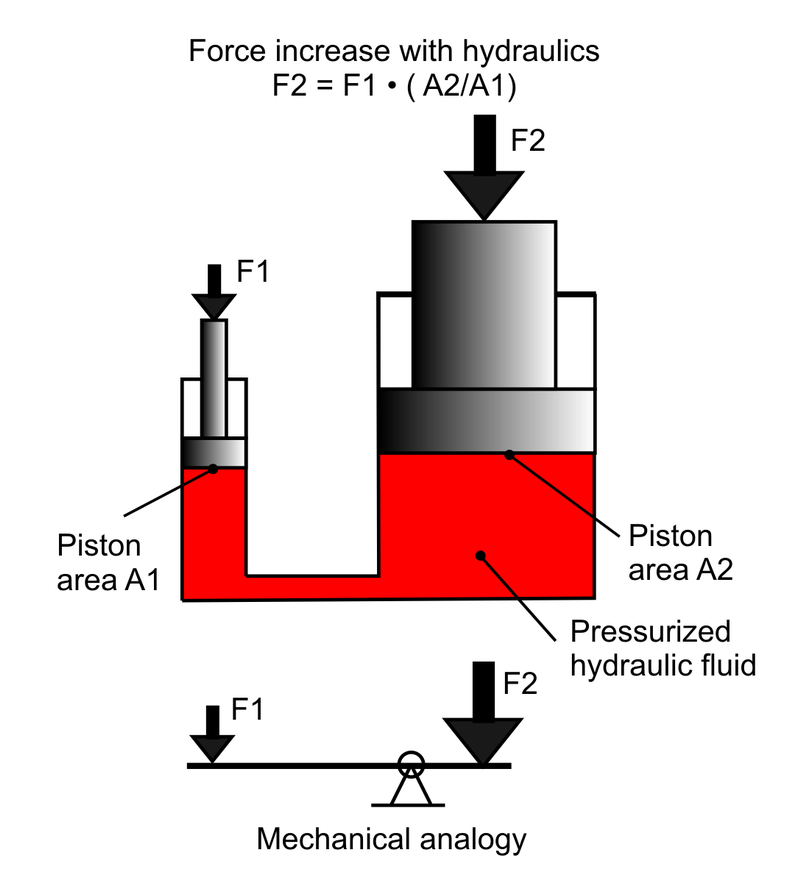
Pascal's principle is used in many hydraulic systems, such as hydraulic press, which is shown in the figure below. There are two pistons: one with a smaller area and one with a bigger area, that are connected with each other via some hydraulic fluid. The pressure that the smaller piston exerts against the liquid will be precisely equal to the pressure the liquid exerts against the bigger cylinder. It is important to stress that not the forces, but pressures are equal.
Pascal's law calculator
Our hydraulic pressure calculator can compute suitable parameters of both pistons in the hydraulic press. To do this, we have used Pascal's law formula, which after appropriate transformations, takes the form of:
where
- F1F1 — Force applied to the first piston;
- F2F2 — Force applied to the second piston;
- A1A1 — Area of the first piston; and
- A2A2 — Area of the second piston.
The pressure of the liquid inside the hydraulic press can be calculated in two simple ways: p=F1/A1p=F1/A1 or p=F2/A2p=F2/A2. Although this is not obvious at first, the principle of energy conservation is fulfilled in the hydraulic press. To lift a heavier object lying on the first piston, we need to move the second piston at a longer distance. We can express it with these equations:
where:
- d1d1 — Distance at which the first piston has moved; and
- d2d2 — Distance at which the second piston has moved.
The total work done by one piston satisfies the relation:
In the Lifting distances and work section of our hydraulic pressure calculator, you can also estimate parameters: d1d1, d2d2, and WW.
Hydraulic calculations
Let's use our hydraulic press calculator to analyze an automobile hydraulic lift. How much force do we need to apply to lift a car with a mass of 1000 kg? Let's go step by step:
-
Pressure is usually exerted on the fluid in the small piston by a compressor. If you assume that the small piston is a circle with a diameter of 3 cm, then you can easily compute that its area equals A1=7.069 cm2A1=7.069 cm2.
-
Similarly, if the bigger piston, which lifts the car, is a circle 30 cm in diameter, then its area equals A2=706.9 cm2A2=706.9 cm2.
-
The weight of car with mass of 1000 kg is F2=1000 kg×9.80665 m/s2F2=1000 kg×9.80665 m/s2 =98066.5 N=98066.5 N, because Earth's acceleration is g=9.80665 m/s2g=9.80665 m/s2.
-
Finally, with our Pascal's law calculator, we can calculate that to lift a car with a mass of 1000 kg, we need only F1=980.7 NF1=980.7 N, which corresponds to the mass of 100 kg, approximately a mass of human body! At the same time, the liquid pressure is p=1387.3 kPap=1387.3 kPa, which is 13.69 times higher than the atmospheric pressure. Check out the pressure conversion calculator to learn how you can switch between different pressure units.
FAQs
- What does the Hydraulic Pressure Calculator do?
- The hydraulic pressure calculator finds the parameters of a basic hydraulic system. Use the calculator above for instant results in your browser.
- Is the Hydraulic Pressure Calculator free to use?
- Yes. All Try To Calculator tools are free and do not require an account.
- Are my inputs stored or sent to a server?
- No. Calculations run locally in your browser. We do not collect the numbers you enter or the results shown.
- Can I use the Hydraulic Pressure Calculator for professional decisions?
- This tool is for education and quick estimates. For medical, legal, tax, or financial decisions, verify results with a qualified professional.
- Where can I find related calculators?
- Browse more Physics tools on Try To Calculator at /physics, or use the related calculators section on this page.
Related calculators
Acceleration
The acceleration calculator estimates acceleration using three different approaches – velocity difference, distance traveled over time, and net force vs. mass.
Physics
Density
Use the density calculator to instantly find how tightly packed an object's molecules are.
Physics
Free fall
Our free fall calculator can find the velocity of a falling object and the height it drops from.
Physics
Projectile motion
Use our projectile motion calculator to analyze a projectile in parabolic motion.
Physics