
LED Resistor Calculator
This LED resistor calculator is a tool for determining what resistor you should use when creating different electronic circuits with LEDs. Thanks to these calculations, you can be sure that you won't damage the diodes with an excessive current.
You can use this LED calculator to find both the required resistance and the power dissipation in a single LED, all LEDs, or in the resistor.
🙋 Check our LED savings calculator and discover the efficiency of LED light bulbs.
LED calculator: an overview
LEDs, or light-emitting diodes, are small electronic components. When current is applied to LEDs, they emit light in various colors, such as red, green, or blue. If the current passing through the diode is too high, though, it will damage the LED.
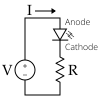
To limit the current passing through the diode, it's common practice to add a resistor to the circuit, as shown in the image above image. We usually add this resistor in series. Even though this method is simple and solves many problems with a basic circuit, we shouldn't apply it to high-current LEDs.
🔎 Learn how diodes work with Shockley diode calculator.
What do you need to know?
In order to calculate the resistance and power dissipation, you need to input a few parameters into this LED resistor calculator:
-
Circuit type. Are your LEDs connected in series or parallel?
-
n – number of connected LEDs.
-
V – supply voltage of your circuit. Typical values are 5, 7, and 12 volts for molex connectors and 1.5 or 9 volts for batteries.
-
Vₒ – voltage drop across one LED. This value depends on the LED color and ranges from 1.7 volts (infrared) to 3.6 (white or blue diodes).
-
Iₒ – current across one LED. Regular LEDs require 20 or 30 mA.
LEDs in series
If you connect a few diodes in series or are calculating the resistor for just one diode, you can use the formulas listed below:
-
Resistance:
R = (V - n × Vₒ) / Iₒ;
-
Power dissipated in a single LED:
Pₒ = Vₒ × Iₒ;
-
Power dissipated in all LEDs (total):
P = n × Vₒ × Iₒ; and
-
Power dissipated in the resistor:
Pr = (Iₒ)² × R.
LEDs in parallel
For LEDs connected in parallel, the LED resistor calculator uses the following equations:
-
Resistance: R = (V - Vₒ) / (n × Iₒ);
-
Power dissipated in a single LED:
Pₒ = Vₒ × Iₒ;
-
Power dissipated in all LEDs (total):
P = n × Vₒ × Iₒ; and
-
Power dissipated in the resistor:
Pr = (n × Iₒ)² × R.
Wondering where these formulas come from? Take a look at the Ohm's law calculator!
FAQs
- What does the LED Resistor Calculator do?
- LED resistor calculator tells you what resistor you should use when connecting LEDs in series or parallel. Use the calculator above for instant results in your browser.
- Is the LED Resistor Calculator free to use?
- Yes. All Try To Calculator tools are free and do not require an account.
- Are my inputs stored or sent to a server?
- No. Calculations run locally in your browser. We do not collect the numbers you enter or the results shown.
- Can I use the LED Resistor Calculator for professional decisions?
- This tool is for education and quick estimates. For medical, legal, tax, or financial decisions, verify results with a qualified professional.
- Where can I find related calculators?
- Browse more Physics tools on Try To Calculator at /physics, or use the related calculators section on this page.
Related calculators
Acceleration
The acceleration calculator estimates acceleration using three different approaches – velocity difference, distance traveled over time, and net force vs. mass.
Physics
Density
Use the density calculator to instantly find how tightly packed an object's molecules are.
Physics
Free fall
Our free fall calculator can find the velocity of a falling object and the height it drops from.
Physics
Projectile motion
Use our projectile motion calculator to analyze a projectile in parabolic motion.
Physics