
Malus Law Calculator
The Malus law calculator is a helpful tool that explains the functional principle of polarizers. Depending on the relative position between the direction of light polarization and the axis of a polarizer, different amounts of light can be transmitted.
By knowing the initial light intensity and polarization orientation, you can easily find the output intensity, which comes from the polarizer, based on Malus law.
🙋 Learn how to choose the ideal polarized sunglasses with sunglasses size calculator.
Light polarization
We can describe light as mutually oscillating electric and magnetic fields forming an electromagnetic wave. These oscillations are perpendicular to each other and simultaneously perpendicular to the direction of wave propagation.
The light is said to be linearly polarized if the orientation of oscillations is constant in time. It is common to say that the direction of light polarization is the same as that of electric field oscillation.
We can obtain polarized light due to reflection on the boundary of two media with different refractive indexes if the angle of incidence equals Brewster's angle or by passing light through some dichroic crystal. Check our Brewster's angle calculator to find the exact angle value.
How does a polarizer work?
Polarizers are usually made of oblong-shaped molecules, all aligned in the same direction. It turns out that if the polarization of the incident beam is the same as the alignment orientation, then the light is most likely to be absorbed.
If the polarization is perpendicular to the long axis of molecules, then it is transmitted almost entirely, and that direction is the axis of the polarizer. If the angle of polarization is something in between, it passes through only partially, and its initial irradiance decreases. We can determine the exact value thanks to the Malus law.
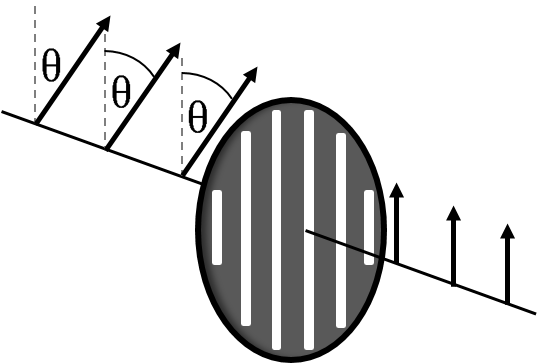
Malus law formula
Irradiance (intensity) of light is the amount of power received on the unit of surface, so we usually measure it in W/m². Considering the wavelengths of photons, we can also convert them into lux using our lumen calculator, obtaining the units of illuminance. We can calculate the light intensity, which passes through the ideal polarizer, as follows:
intensity = initial intensity × cos²θ,
where:
initial intensity– Irradiance of the incident light;θ– Angle between the light polarization and the axis of the polarizer; andintensity– Output irradiance.
Irradiance changes under rotation – an example
Let's say that you want to check how the intensity of polarized light changes while you rotate your polarizer:
-
Choose a few different values of the axis of polarizer orientation with respect to the polarization of incident rays, e.g., θ₁ = 20°, θ₂ = 45°, θ₃ = 70°.
-
Determine cosθ of these angles, which are 0.939, 0.707, and 0.342, respectively.
-
Find squares of these values: 0.883, 0.5, 0.117.
-
Multiply them by the initial intensity, say I₀ = 5 W/m²: I₁ = 4.415 W/m², I₂ = 2.5 W/m², I₃ = 0.585 W/m².
-
Or simply enter data into this Malus law calculator and save your time!
You can always express obtained results as the percentages of the initial intensity.
Polarizers in everyday life
Have you ever wondered why it is possible to remove light reflections on the water surface only by rotating the polarizing filter in your camera? Now you know the secret and, what's more, you can easily predict the effect using the Malus law calculator. Polarized sunglasses are also based on this phenomenon so that they can block a vast majority of polarized light during sunny days.
FAQs
- What does the Malus Law Calculator do?
- With this Malus law calculator, you can find the intensity of light that passes through the polarizer, taking into account the direction of its initial polarization. Use the calculator above for instant results in your browser.
- Is the Malus Law Calculator free to use?
- Yes. All Try To Calculator tools are free and do not require an account.
- Are my inputs stored or sent to a server?
- No. Calculations run locally in your browser. We do not collect the numbers you enter or the results shown.
- Can I use the Malus Law Calculator for professional decisions?
- This tool is for education and quick estimates. For medical, legal, tax, or financial decisions, verify results with a qualified professional.
- Where can I find related calculators?
- Browse more Physics tools on Try To Calculator at /physics, or use the related calculators section on this page.
Related calculators
Acceleration
The acceleration calculator estimates acceleration using three different approaches – velocity difference, distance traveled over time, and net force vs. mass.
Physics
Density
Use the density calculator to instantly find how tightly packed an object's molecules are.
Physics
Free fall
Our free fall calculator can find the velocity of a falling object and the height it drops from.
Physics
Projectile motion
Use our projectile motion calculator to analyze a projectile in parabolic motion.
Physics