
Parallel Capacitor Calculator
This parallel capacitor calculator allows you to estimate the resulting capacitance in a circuit. You can simulate the arrangement of up to 10 separate capacitors in parallel.
Additionally, we provide the formula for parallel capacitorsand an explanation of where it comes from. We also describe the differences between capacitors in series and parallel, and how they correspond to the formulas for resistors.
🙋 If in doubt, you can decode any capacitance with capacitor calculator.
Adding capacitors in parallel
A capacitor is one of the most important electronic components. It acts as a place where we can store some electric charge. Capacitors may be combined both in series and in parallel. The question is: What is the resulting capacitance for a circuit composed entirely of capacitors in parallel? Let's work it out together, using parallel plate capacitors as an example!
🔎 You can read more about parallel plate capacitors in our capacitance calculator.
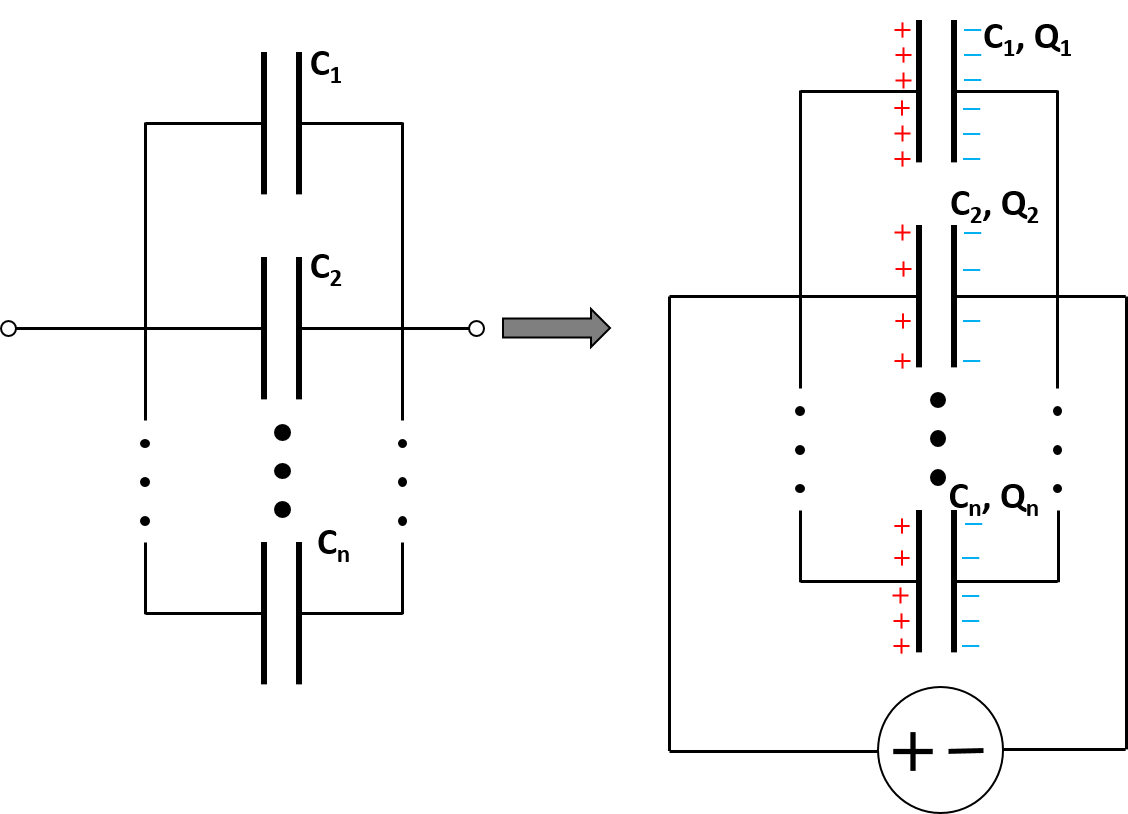
When we arrange capacitors in parallel in a system with voltage source V, the voltages over each element are the sameand equal to the source capacitor:
V₁ = V₂ = … = V.
The general formula for the charge, Qi, stored in capacitor, Ci, is:
Qi = Vi × Ci.
If we want to replace all the elements with the substitutionary capacitance, C, we need to realize that the overall charge, Q, is the sum of all charges:
Q = Q₁ + Q₂ + …,
which we can also write as:
V × C = V × C₁ + V × C₂ + ….
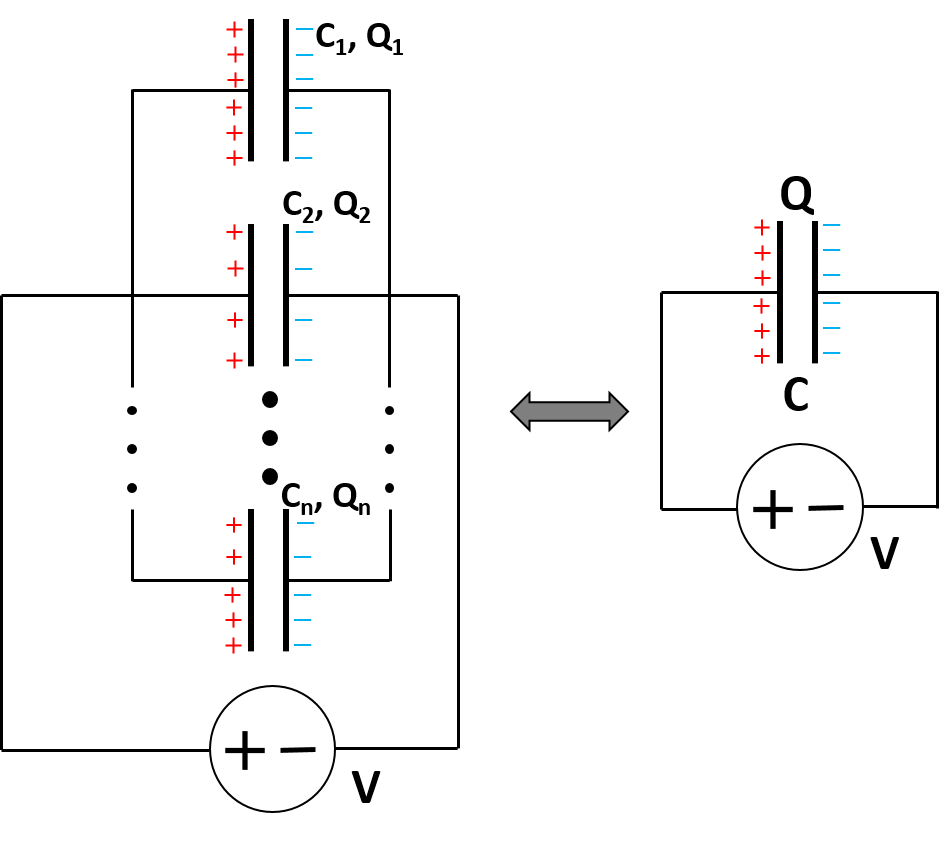
Dividing both sides by V, we obtain the formula for the output capacity:
C = C₁ + C₂ + ….
As you can see, the capacitors in parallel formula is exactly the same as that for series resistors, which is simply the sum of all the individual components. It turns out that the equation for capacitors in series resembles the one for parallel resistors as well as parallel inductors.
🔎 If you need to arrange capacitors in series, our capacitors in series calculator will save you time!
In general, if we want to construct a system with higher capacitance, we should arrange the capacitors in parallel. On the other hand, if the capacitors are in series, the resulting capacity is lower than any of the individual components.
How to use the parallel capacitor calculator?
Let's arrange a few capacitors in parallel and find the resulting capacitance. The starting set consists of the following capacitors: C₁ = 30 mF, C₂ = 500 µF, C₃ = 6 mF, C₄ = 750 µF.
-
To make our life easier, convert the units of capacitance so they are the same, e.g., mF: C₁ = 30 mF, C₂ = 0.5 mF, C₃ = 6 mF, C₄ = 0.75 mF
-
Sum up all the values: C₁ + C₂ + C₃ + C₄ = 30 mF + 0.5 mF + 6 mF + 0.75 mF = 37.25 mF
-
We can write the result for capacitors in parallel in a different form, using scientific notation:C = 3.725·10⁻² F
Although the evaluation isn't complex, we recommend you use our parallel capacitor calculator to check if your calculation is correct!
FAQs
- What does the Parallel Capacitor Calculator do?
- Check out this parallel capacitor calculator to evaluate the resulting capacity in this kind of circuit. Use the calculator above for instant results in your browser.
- Is the Parallel Capacitor Calculator free to use?
- Yes. All Try To Calculator tools are free and do not require an account.
- Are my inputs stored or sent to a server?
- No. Calculations run locally in your browser. We do not collect the numbers you enter or the results shown.
- Can I use the Parallel Capacitor Calculator for professional decisions?
- This tool is for education and quick estimates. For medical, legal, tax, or financial decisions, verify results with a qualified professional.
- Where can I find related calculators?
- Browse more Physics tools on Try To Calculator at /physics, or use the related calculators section on this page.
Related calculators
Acceleration
The acceleration calculator estimates acceleration using three different approaches – velocity difference, distance traveled over time, and net force vs. mass.
Physics
Density
Use the density calculator to instantly find how tightly packed an object's molecules are.
Physics
Free fall
Our free fall calculator can find the velocity of a falling object and the height it drops from.
Physics
Projectile motion
Use our projectile motion calculator to analyze a projectile in parabolic motion.
Physics