
Kinetic Energy of a Pendulum Calculator
The humble pendulum! Somehow, pendulums seem to bring back traumatic memories. For (former) students, those memories take the shape of cryptic equations and blackboards filled with unreadable signs… For old houses, it's all about destruction and demolition. Let's build bridges of understanding to show how pendulums and wrecking balls are not just full of science and mighty power, but they can also be fun as F…LYING!
We made a video about pendulums! Watch it here:
The basics of the mathematical pendulum
Let's start from the beginning: what is a (mathematical) pendulum? A pendulum is simply a weight hanging off a rope or stick that is allowed to swing freely. The "mathematical" version of it is the approximation in which we ignore friction losses (with air or in the rotation) as well as the weight of the rod or rope from which the weight is hanging.
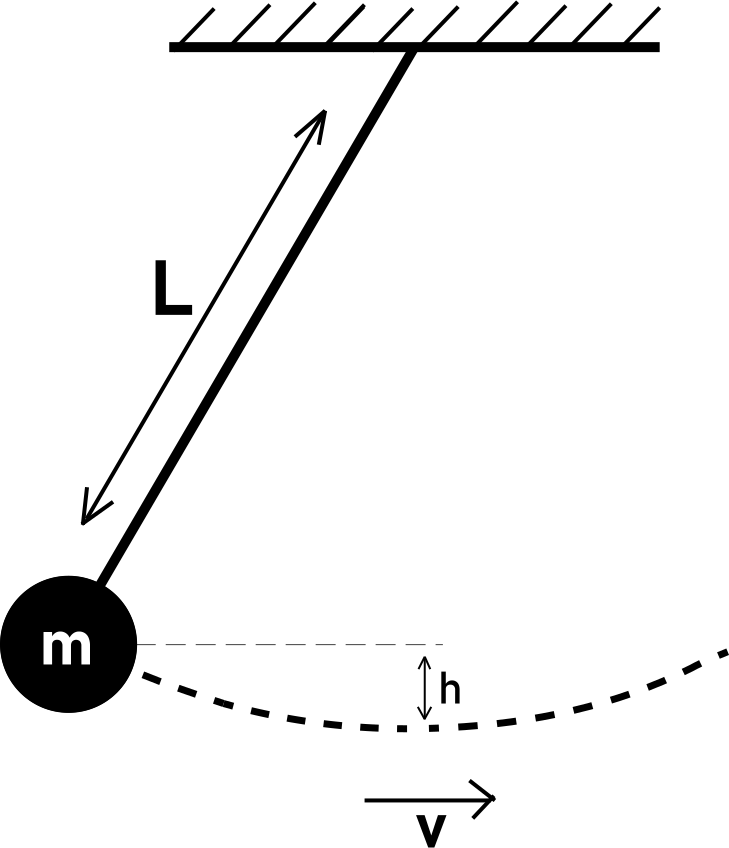
These approximations are good enough for all but the most precise calculations and help us focus on the physics at play without having to deal with the hurdles of a real-world setup where nothing is quite perfect. Using these approximations, we can relate the period of a pendulum to its length with this simple equation:
where TT is the period, LL is the length of the rope/rod and gg is the acceleration due to gravity (9.8 m/s29.8 m/s2 on the surface of the Earth on average).
This is generally taught as the most important equation of a pendulum, since this is often taught by physicists or mathematicians. However, if we are interested in the utility of a pendulum (as a wrecking ball, for example) this equation is not all that useful. It tells us nothing about the energy of the pendulum, the speed at which it moves, or how all that relates to its destructive power, for example.
Energy of a pendulum — a different way of thinking
If we want to know how a pendulum would interact with other objects, we need more information. We can get that by looking at a physical pendulum calculator or by looking at how to calculate potential energy (energy due to height) and kinetic energy (energy of movement) and how they relate to each other.
Staying with the mathematical approximation, the total energy of a pendulum is always constant, getting transformed from potential energy into kinetic energy and vice-versa. To calculate these quantities at any point in the pendulum's movement, we need to know the mass of the pendulum, as well as its vertical height.
The equation relating the transformation of energy in the pendulum is the following:
and can be expanded into:
Where mm is the mass of the pendulum, hh is the height of the weight, and vv is the speed at which the weight is moving. The total energy (EtotalEtotal) seems to be unknown but it can be easily calculated using a point where there's only kinetic or potential energy. For example, if we take the pendulum at its highest point (h=hmaxh=hmax) then we know that the speed is 0 m/s0 m/s and, therefore Etotal=m⋅hmax⋅gEtotal=m⋅hmax⋅g.
🙋 To discover the rest of the pendulum's math, visit pendulum period calculator and pendulum frequency calculator.
Uses of pendula (yes, that's the plural form)
Although a pendulum is very simple to build, it offers a surprisingly wide variety of applications. In fact, you've probably encountered many pendula in your life without even realizing that. Here's a few examples of where they can be found in our everyday lives:
- Pendulum clocks aren't as popular as they used to be, but they deserve mention considering that they've been around since the 17th century. They use the repetitiveness of pendulum motion to keep track of time — every time the bob passes through its equilibrium position, an appropriate wheel moves, and the hand follows.
- Similar mechanism is used in metronomes, devices used mainly by musicians. They produce a sound at regular intervals to help musicians play in time. They may be handy if you're struggling with keeping the rhythm.
- In regions frequently haunted by earthquakes, many buildings use friction pendula as seismic isolators. The motion of the ground causes the pendulum to oscillate, reducing the risk of structural damage.
- If, however, you want to demolish the building instead of protecting it, look no further — a wrecking ball is one of the ways to go. It's basically a large, massive pendulum that uses its kinetic energy to exert force onto an object to break it. The longer and heavier it is, the more energy is available and the more destruction you can sow.
- Many rides in amusement parks use a pendulum mechanism; they're simply a bit more sophisticated, especially if they can also sway vertically. A typical playground swing could also be an example, with you becoming a part of the bob.
- Scientific instruments such as seismometers, which are used to detect seismic waves and detect events such as earthquakes. Another type of device is a gravimeter — a special kind of accelerometer used specifically to determine the acceleration due to gravity, gg. Although we usually treat it as a constant, it actually varies depending on the location on the Earth!
There are also other uses of pendula, such as hypnosis (allegedly) or censers used in some religious practices. As you can see, there's a reason why they're so widely studied — they make up the basis of many objects and can be easily studied with little equipment!
FAQs
- What does the Kinetic Energy of a Pendulum Calculator do?
- This calculator and video combination helps you compute the kinetic energy of a pendulum so that you can better understand how to use a pendulum in the real world. Use the calculator above for instant results in your browser.
- Is the Kinetic Energy of a Pendulum Calculator free to use?
- Yes. All Try To Calculator tools are free and do not require an account.
- Are my inputs stored or sent to a server?
- No. Calculations run locally in your browser. We do not collect the numbers you enter or the results shown.
- Can I use the Kinetic Energy of a Pendulum Calculator for professional decisions?
- This tool is for education and quick estimates. For medical, legal, tax, or financial decisions, verify results with a qualified professional.
- Where can I find related calculators?
- Browse more Physics tools on Try To Calculator at /physics, or use the related calculators section on this page.
Related calculators
Acceleration
The acceleration calculator estimates acceleration using three different approaches – velocity difference, distance traveled over time, and net force vs. mass.
Physics
Density
Use the density calculator to instantly find how tightly packed an object's molecules are.
Physics
Free fall
Our free fall calculator can find the velocity of a falling object and the height it drops from.
Physics
Projectile motion
Use our projectile motion calculator to analyze a projectile in parabolic motion.
Physics