
Poiseuille's Law Calculator
The Hagen-Poiseuille's law calculator is a multi-task tool for computing not only the flow rate of laminar flow in a long, cylindrical pipe of constant cross-sectional, but also the fluid/airway resistance and the pressure change.
Feeling confused? 🤯
Move onto our article below for a simple explanation of Hagen-Poiseuille's equation in biophysics and some useful examples, such as the water pipe flow velocity profile or the blood flow in blood vessels.
What is Poiseuille's equation? (also Hagen-Poiseuille equation)
Hagen-Poiseuille law is a simple formula that we use in fluid dynamics calculations.
We already mentioned that this equation describes the laminar flow in a cylindrical container - in simple words, try to imagine a straight pipe with water flowing through it. 🚰
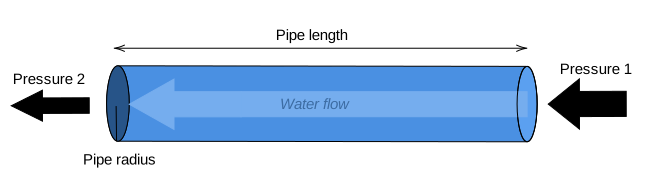
The Poiseuille's law equation (Hagen-Poiseuille law) describes how much water flows through the pipe in one second, depending on the:
-
The fluid's viscosity (thickness of the liquid, its ability to move against the friction of the pipe's walls);
-
The pipe's length;
-
The pipe's radius (or diameter); and
-
The difference in pressure between the beginning and the end of the pipe. Our differential pressure calculator can help you find this value for some selected systems.
Poiseuille flow equation and its applicability
Since we already know what Poiseuille's equation is, it's time to find out when we have to use it.
You guessed right — Poiseuille's law can be used in plumbing since pipes are involved (flow resistance equation). Humans, however, are indeed creative creatures:
-
You can use this equation when estimating blood flow in blood vessels, and to describe the different processes in the human body that involve fluids (in that case, the Poiseuille's law equation acts as a blood flow equation);
-
We can use it to estimate the airflow resistance in human airways. This is incredibly important in the research on asthma and COPD;
-
We also use Poiseuille's flow equation to describe the work of the kidney and the pressure in tubules and glomeruli;
-
Poiseulle's law equation was essential in the creation of artificial kidney and hemodialysis machines; and
-
We can also use the Hagen-Poiseuille equation in engine design 🚀
Would you like to know more? Check one of our flowing calculators:
How to use Poiseuille's law calculator
Our Poiseuille's equation calculator requires only 4 simple steps (or 3 if you want to compute flow resistance):
- Enter the dynamic viscosity (μμ):
Its basic unit is Pa⋅sPa⋅s. For different pressure units, check the pressure converter.
-
Enter the radius of the pipe — it's equal to half of its diameter.
-
Enter the length of the pipe.
-
Find the pressure change (only required for the flow rate).
If you don't know the pressure change (ΔpΔp), expand the Initial and final pressure section and enter the desired values for pressure or subtract the final pressure (p2p2) from the initial pressure (p1p1) yourself, following the formula below:
💡 Our calculator allows you to enter whole equations into the blank fields. Try to enter e.g. 10−510−5. We will calculate everything for you automatically.
The results of the Poiseuille's law calculator will include both the flow rate and the resistance.
Flow rate — equation & example
Here's the Poiseuille flow equation:
where:
- QQ — Flow rate (m3/sm3/s);
- ππ — Our famous and beloved constant pi, equals to 3.14159..3.14159..;
- μμ — Dynamic viscosity (Pa⋅sPa⋅s);
- rr — Radius of the pipe;
- ll — Length of the pipe; and
- ΔpΔp — Pressure change (PaPa).
We'd like to discover the change in blood flow when the blood vessels contract using the blood flow equation (a specific case of Poiseuille's law equation).
This situation is very straightforward to imagine — you're relaxing in a hot, Finnish sauna, and you know you'll have to leave and walk out onto the freezing snow. Your skin's blood vessels will contract — but how will it affect your skin's blood flow?
🙋 In some situations, for example, with turbulent fluids, Poiseuille's law can be replaced with the more empirical Darcy-Weisbach equation: we detailed it at the Darcy-Weisbach calculator.
💡 So how does the body decrease the blood vessel radius? Blood vessels are connected only to the sympathetic nervous system — its fibers cause the muscles that encircle the vessels to contract. This way, your body can send the blood flow to more important organs, such as the brain or heart.
What do we know?
- Our original vessels' radius was 1 mm=0.001 m1 mm=0.001 m;
- The pressure at the beginning of the vessel system was equal to 120 mmHg=15998.7 Pa120 mmHg=15998.7 Pa;
- The pressure at the end was equal to 80 mmHg=10665.8 Pa80 mmHg=10665.8 Pa;
- Our dynamic viscosity is 0.005 Pa⋅s0.005 Pa⋅s;
- Total length of our vessels is 2 m2 m; and
- Our vessels contracted by 3/43/4 - they're 1/41/4 of their original size.
Let's create the original blood flow equation:
So how does the blood flow change with the radius being 1/4 of its original size?.
Then:
Let's calculate the ratio of QQ and Q2Q2 :
That is equal to:
The blood flow will change by a factor 256256 if the radius reduces by a factor of 44.
Why? Radius in our equation is taken to the power of 44, so we could also use the following formula: 44=25644=256.
Flow resistance — equation & examples
Here's the Hagen-Poiseuille equation for flow resistance that we use in this Poiseuille's law calculator:
where:
- RR — Resistance (Pa⋅s/m3Pa⋅s/m3);
- ππ — Pi again;
- μμ — Dynamic viscosity (Pa⋅sPa⋅s);
- rr — Radius of the pipe; and
- ll — Length of the pipe.
Now that we know what Poiseuille's equation is, let's calculate the radius of an airway with a flow resistance of 0.0315 Pa⋅s/m30.0315 Pa⋅s/m3, length of 0.5 m0.5 m, and viscosity of 2 Pa⋅s2 Pa⋅s.
FAQs
- What does the Poiseuille's Law Calculator do?
- Our Hagen-Poiseuille's law calculator is a simple way to calculate the flow rate, resistance, or pressure change of a fluid or gas in a pipe. Use the calculator above for instant results in your browser.
- Is the Poiseuille's Law Calculator free to use?
- Yes. All Try To Calculator tools are free and do not require an account.
- Are my inputs stored or sent to a server?
- No. Calculations run locally in your browser. We do not collect the numbers you enter or the results shown.
- Can I use the Poiseuille's Law Calculator for professional decisions?
- This tool is for education and quick estimates. For medical, legal, tax, or financial decisions, verify results with a qualified professional.
- Where can I find related calculators?
- Browse more Physics tools on Try To Calculator at /physics, or use the related calculators section on this page.
Related calculators
Acceleration
The acceleration calculator estimates acceleration using three different approaches – velocity difference, distance traveled over time, and net force vs. mass.
Physics
Density
Use the density calculator to instantly find how tightly packed an object's molecules are.
Physics
Free fall
Our free fall calculator can find the velocity of a falling object and the height it drops from.
Physics
Projectile motion
Use our projectile motion calculator to analyze a projectile in parabolic motion.
Physics