
Wheatstone Bridge Calculator
Wheatstone bridge calculator allows you to determine the unknown resistance in a Wheatstone bridge circuit. You can use this calculator for both balanced and unbalanced Wheatstone bridges.
Continue reading to know what the Wheatstone bridge is and how to calculate resistance using the Wheatstone bridge equation. You will also find some of its applications in electronic systems.
What is a Wheatstone bridge?
The Wheatstone bridge is a circuit that measures unknown electrical resistance. It is basically a rhombus-shaped network of four resistance arms connected to an external voltage source (see figure 1). The circuit gets its name because it was developed by Charles Wheatstone, and a bridge joins the resistor arms.
The Wheatstone bridge circuits are commonly used in electronic sensors to precisely detect small changes in resistances. In fact, most strain gauges use the Wheatstone bridge circuits.
🙋 Another bridge circuit that is commonly used in electronic circuits to convert AC supply voltage to DC is the bridge rectifier. You can learn more about it from the bridge rectifier calculator.
Circuit of Wheatstone bridge
Figure 1 shows the circuit of a Wheatstone bridge. The resistors R1R1 (arm AD) and R3R3 (arm AB) have a fixed value, whereas, the resistor R2R2 (arm DC) is variable. The unknown resistance RxRx is connected in arm BC.
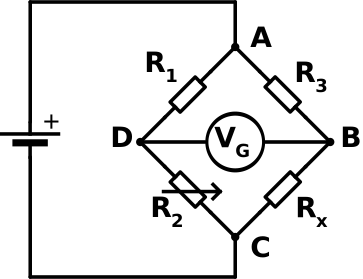
The resistances R1R1 (arm AD) and R2R2 are connected in series and make one voltage divider circuit. The same goes for the resistances R3R3 (arm AD) and RxRx, which make the second voltage divider circuit. These two series combinations of resistors are then connected in a parallel arrangement. For a quick reminder of the various resistor combinations, check out the series resistor calculator and parallel resistor calculator.
We can measure the output of the Wheatstone bridge between terminals B and D by using a device called a galvanometer.
Wheatstone bridge formula
With a supply voltage VV applied across the bridge, we can write the formula for the output voltage VGVG of an unbalanced Wheatstone bridge as:
To measure the unknown resistance RxRx, we need to vary the resistance R2R2 until the galvanometer gives zero reading. This means that no current flows through the arm DB, as both points D and B are at the same potential. Under this condition, we say that the Wheatstone bridge is balanced.
For a balanced Wheatstone bridge:
Hence, we can modify the unbalanced Wheatstone bridge equation as:
A galvanometer is a very sensitive device. Hence, it is possible to make null measurements up to very high precision. As a result, the resistance measurement using the Wheatstone bridge is very accurate (up to four significant figures).
How to calculate resistance in the Wheatstone bridge?
To understand how to calculate an unknown resistance in the Wheatstone bridge, let us consider an example of a balanced Wheatstone bridge where R1=6 ΩR1=6 Ω, R2=9 ΩR2=9 Ω, R3=4 ΩR3=4 Ω, and V=3.0 VV=3.0 V.
As the circuit is in a balanced state, i.e., the galvanometer does not show any deflection, we can use the Wheatstone bridge formula:
Hence, the unknown resistance is 6 Ω6 Ω.
How to use the Wheatstone bridge calculator?
Now that you know how to calculate resistance in the Wheatstone bridge, let us solve the same problem using the Wheatstone bridge calculator.
-
Using the drop-down menu, select "Value of RxRx for balanced bridge".
-
Input the values of known resistances, R1=6 ΩR1=6 Ω, R2=9 ΩR2=9 Ω, and R3=4 ΩR3=4 Ω.
-
The tool will use the Wheatstone bridge equation to calculate the value of the unknown resistance Rx=6 ΩRx=6 Ω and display it.
-
In case you want to use the Wheatstone bridge calculator to calculate the voltage across the bridge, VGVG, you need to enter the values of input voltage and the four resistances R1R1, R2R2, R3R3, and RxRx.
FAQs
- What is the Wheatstone bridge principle?
- According to the Wheatstone bridge principle, when the bridge is balanced, the resistance of the four arms that form the bridge are proportional to each other, i.e., R₁ / R₂ = R₃ / Rₓ.
- How to calculate the equivalent resistance of the Wheatstone bridge?
- To calculate the equivalent resistance of a Wheatstone bridge in a balanced state, follow the given instructions: Add the two sets of resistors in series to get their respective equivalent resistances. Now add the reciprocal of the two equivalent resistances from step 1. Take the reciprocal of the value in step 2. Congrats! You have calculated the equivalent resistance of a Wheatstone bridge.
- What is a Wheatstone bridge used for?
- Some common applications of the Wheatstone bridge circuit are: To precisely measure resistances by comparing it with known resistances. For strain measurements to detect any relative change in resistance due to mechanical factors like force, pressure, etc. by using a strain gauge. For temperature measurements by using a thermistor (temperature-sensitive resistor) in place of one of the resistances.
- How much is the output current through a Wheatstone bridge in balanced condition?
- Zero. When a Wheatstone bridge is balanced, the potential difference across the output of the bridge is null, hence, the output current through it is also zero.
- How to use the Wheatstone bridge for resistance measurement?
- To use the Wheatstone bridge for resistance measurement, proceed as follows: Adjust the value of the variable resistor until the galvanometer shows no deflection. Now, your bridge is in a balanced state, you can determine the value of unknown resistance by using the Wheatstone bridge formula. Multiply the value of the variable resistance by the ratio of the known resistances in the other two arms of the bridge. You have measured the unknown resistance using a Wheatstone bridge!
Related calculators
Acceleration
The acceleration calculator estimates acceleration using three different approaches – velocity difference, distance traveled over time, and net force vs. mass.
Physics
Density
Use the density calculator to instantly find how tightly packed an object's molecules are.
Physics
Free fall
Our free fall calculator can find the velocity of a falling object and the height it drops from.
Physics
Projectile motion
Use our projectile motion calculator to analyze a projectile in parabolic motion.
Physics