
tPA Calculator – Stroke Dosing
The tPA calculator double-checks the correct dose of alteplase needed for your stroke patients.
In the article below, we'll teach you how to calculate the tPA dose for a stroke - we'll also talk about possible alteplase antidote and present the basic rules of tPA administration. 💉
❗ Remember, our tool cannot be used as the one and only source of clinical knowledge - always double-check your calculations or consult a more experienced physician.
What is alteplase – tPA?
tPA stands for the tissue plasminogen activator - a kind of enzyme present in our blood vessels, responsible for dissolving blood clots and maintaining a liquidity of our blood.
Alteplase is a recombinant, man-made version of this protein (rtPA). To reverse its toxicity effects in case of an emergency, we usually use the alteplase antidote: aminocaproic acid.
How does alteplase and tPA work?
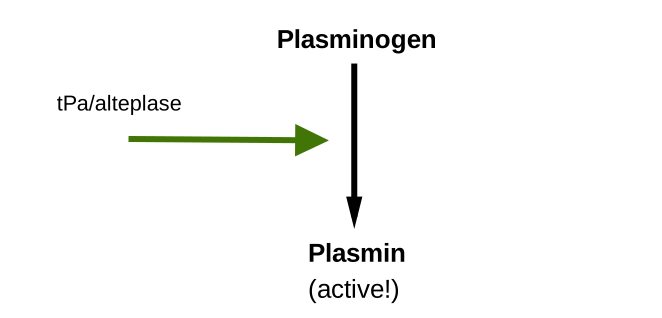
tPA works by triggering the conversion of inactive plasminogen to active plasmin. Plasmin works by dissolving the fibrin clots in our bloodstream - this process is called fibrinolysis.
We usually use the tissue plasminogen activators to treat:
- Stroke (remember - tPA doses for stroke and other diseases are entirely different);
- Heart attack (see: HEART score calculator) 💔;
- Pulmonary embolism (see: Geneva Score calculator);
- Thrombosis of an artificial valve /peripheral artery (see: CHA₂DS₂ VASc calculator);
- Frostbites; and
- Pleural effusion cased by pneumonia.
💡 An enzymeis a kind of active protein that's capable of triggering different chemical reactions in organisms. You may find out more using our enzyme kinetics tool - the Michaelis-Menten equation Calculator.
How is tPA administered?
We can perform tPA administration in a variety of ways:
- Intravenously (IV) - into the vein;
- Intracatheter - into the catheter;
- Intra-hemodialysis catheter - into the hemodialysis catheter;
- Intra-arterial (off-label) - might be used in a case of a frostbite or arterial occlusion; and
- Intrapleural - between the pleurae, membranes that surround lungs and the chest cavity.
We usually administer tPA intravenously - that's the foundation our alteplase calculator is based on.
💡 Recommended dosage: 0.9 mg/kg
Maximum dosage: 90 mg
-
If our patient weights <100 kg: ⬇️
- During the first 1 minute:
- IV bolus
- 10% of recommended dose (0.09 mg/kg)
- During the next 60 min
- IV continuous infusion
- 90% of recommended dose (0.81 mg/kg)
- During the first 1 minute:
-
If our patient weights ≥100 kg: ⬆️
- During the first 1 minute:
- IV bolus
- 9 mg
- During the next 60 min
- IV continuous infusion
- 81 mg
- During the first 1 minute:
How to calculate tPA dose?
tPA dosage for stroke should be calculated using the patient's weight. That's why we shouldn't use the tPA dosing charts since they might be not as accurate as we want them to be.
Our alteplase calculator uses the following equation, based on the recommended IV (intravenous) dose:
💡 Maximum dosage allowed: 90 mg
Dosage IV (mg) = 0.9 × Weight (kg),
where:
Dosage IVis given in milligrams (mg); andWeightshould be given in kilograms (kg).
tPA calculation example:
Our patient is a male with acute stroke symptoms. He weighs 70 kg.
Dosage IV = 0.9 × 70 kg
Dosage IV = 63 mg
We should administer 63 mg of tPA intravenously. 👍
FAQs
- What does the tPA Calculator do?
- The tPA calculator allows you to quickly find the correct dosage of alteplase for a stroke patient. Use the calculator above for instant results in your browser.
- Is the tPA Calculator free to use?
- Yes. All Try To Calculator tools are free and do not require an account.
- Are my inputs stored or sent to a server?
- No. Calculations run locally in your browser. We do not collect the numbers you enter or the results shown.
- Can I use the tPA Calculator for professional decisions?
- This tool is for education and quick estimates. For medical, legal, tax, or financial decisions, verify results with a qualified professional.
- Where can I find related calculators?
- Browse more Health tools on Try To Calculator at /health, or use the related calculators section on this page.
Based on 1 source
Related calculators
Vaccine queue UK
The vaccine queue calculator for the UK estimates where you are in the queue to get your COVID vaccine based on your age, health, and job.
Health
Body shape
The body shape calculator determines your body type based on bust, waist, and hip measurements.
Health
Height
This height calculator predicts a child's adult height through two distinct methods: the Khamis-Roche formula and the Mid-Parental Height formula.
Health
BMR - Harris-Benedict equation
Harris-Benedict calculator uses one of the three most popular BMR formulas. Knowing your BMR (basal metabolic weight) may help you make important decisions abou
Health