
Cosine Calculator
This cosine calculator is a twin tool to our sine calculator – add to them the tangent calculator, and you'll have a pack of the most popular trigonometric functions. Simply type the angle – in degrees or radians – and you'll find the cosine value instantly.
Read on to understand what is a cosine and to find the cosine definition, as well as a neat table with cosine values for basic angles, such as cos 0°, cos 30°, or cos 45°.
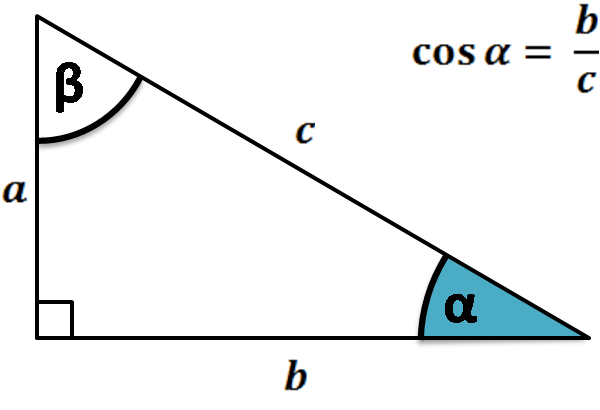
What is cosine? Cosine definition
Cosine is one of the most basic trigonometric functions. It may be defined based on a right triangle or unit circle, in an analogical way as the sine is defined:
The cosine of an angle is the length of the adjacent side divided by the length of the hypotenuse.
cos(α) = adjacent / hypotenuse = b / c
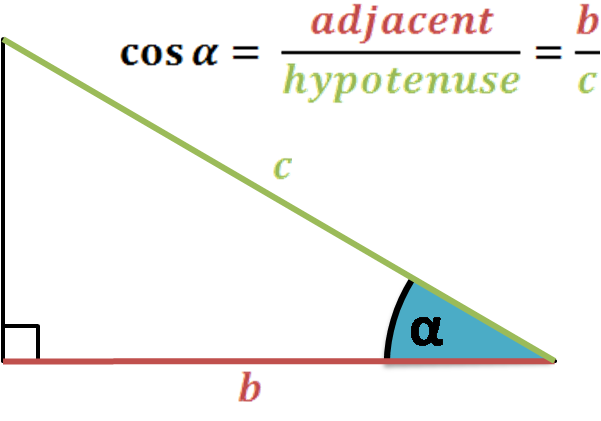
If you're not sure what the adjacent and hypotenuse are (and opposite, as well), check out the explanation in the sine calculator (link at the top of this article).
The name cosine comes from the Latin prefix co- and sine function – so it literally means sine complement. And, indeed, the cosine function may be defined that way: as the sine of the complementary angle – the other non-right angle. The abbreviation of cosine is cos, e.g., cos(30°).
Important properties of a cosine function:
- Range (codomain) of a cosine is -1 ≤ cos(α) ≤ 1;
- Cosine period is equal to 2π;
- It's an even function (while sine is odd!), which means that cos(-α) = cos(α); and
- Cosine definition is essential to understand the law of cosines – a very useful law to solve any triangle. Discover it with our law of cosines calculator!
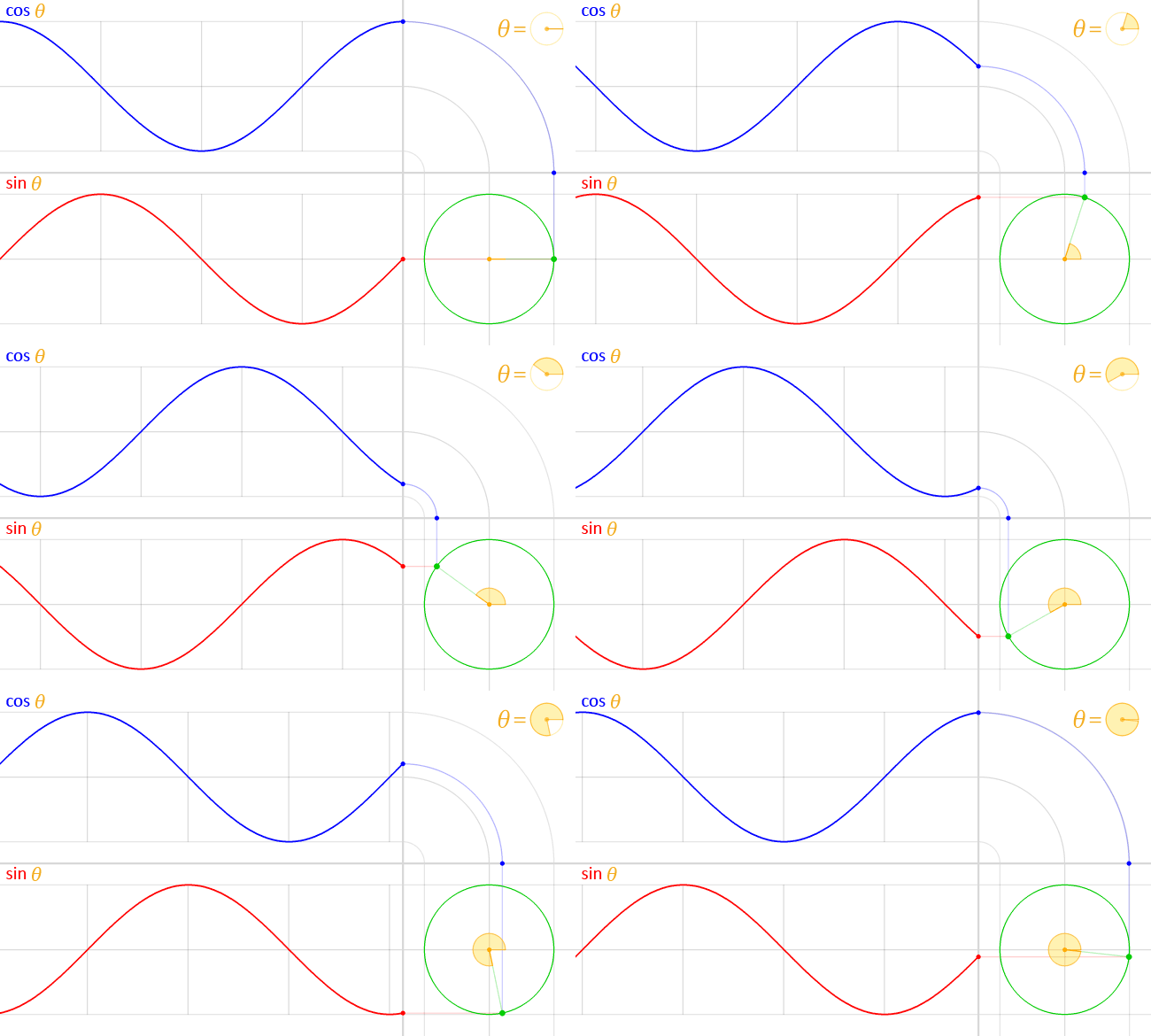
Cosine graph and table (cos 0, cos 30 degrees, cos 45 degrees...)
The image below shows the cosine function in <-2π, 2π> range. Also, if you'd like to learn how to play around with it, make sure to check the phase shift calculator.

The exact cosine value is particularly easy to remember and to define for certain angles – you probably learned that cos 0° = 1, cos 30° = √3/2, or cos 45° = √2/2. Other basic angles are shown in the table:
α (angle) | sin(α) | ||
|---|---|---|---|
Degrees | Radians | Exact | Decimal |
0° | 0 | 1 | 1 |
15° | π/12 | (√6 + √2) / 4 | 0.9659258263 |
30° | π/6 | √3/2 | 0.8660254038 |
45° | π/4 | √2/2 | 0.7071067812 |
60° | π/3 | 0.5 | 0.5 |
75° | 5π/12 | (√6 - √2) / 4 | 0.2588190451 |
90° | π/2 | 0 | 0 |
105° | 7π/12 | -(√6 - √2) / 4 | -0.2588190451 |
120° | 2π/3 | -0.5 | -0.5 |
135° | 3π/4 | -√2/2 | -0.7071067812 |
150° | 5π/6 | -√3/2 | -0.8660254038 |
165° | 11π/12 | -(√6 + √2) / 4 | -0.9659258263 |
180° | π | -1 | -1 |
Moreover, you can observe how the cosine function behaves according to the quadrant in which it lays. Remember the periodicity of the cosine function cos(α + 360°) = cos(α) if your angle is not shown in the table below.
Quadrant / Border | Degrees | Radians | Value | Sign | Monotony | Convexity |
|---|---|---|---|---|---|---|
0° | 0 | 1 | Maximum | |||
1st Quadrant | 0° < α < 90° | 0 < α < π/2 | 0 < cos(α) < 1 | + | Decreasing | Concave |
90° | π/2 | 0 | Root, inflection | |||
2nd Quadrant | 90° < α < 180° | π/2 < α < π | -1 < cos(α) < 0 | - | Decreasing | Convex |
180° | π | -1 | Minimum | |||
3rd Quadrant | 180° < α < 270° | π < α < 3π/2 | -1 < sin(α) < 0 | - | Increasing | Convex |
270° | 3π/2 | 0 | Root, inflection | |||
4th Quadrant | 270° < α < 360° | 3π/2 < α < 2π | 0 < sin(α) < 1 | + | Increasing | Concave |
Example: how to use a cosine calculator
Now you got the hang of what is cosine; using this cosine calculator is a piece of cake!
-
Enter the angle. Switch between the units with a simple click on the unit name. Let's take 40° as an example.
-
Keep calm and read the result – in our case, cos(40°) ≈ 0.766 (remember, it's an approximate value; an exact cosine value can be found only for specific cases).
Give this cosine calculator a go! Play around by typing the cosine value and finding the angle. The only thing to notice is that our tool will show you the angles in 0-180° range – as you know about the periodicity and that the cosine is an even function, it shouldn't be a problem for you to find other possible solutions.
FAQs
- What does the Cosine Calculator do?
- This cosine calculator helps to find the cosine value for a specific angle in degrees or radians. Use the calculator above for instant results in your browser.
- Is the Cosine Calculator free to use?
- Yes. All Try To Calculator tools are free and do not require an account.
- Are my inputs stored or sent to a server?
- No. Calculations run locally in your browser. We do not collect the numbers you enter or the results shown.
- Can I use the Cosine Calculator for professional decisions?
- This tool is for education and quick estimates. For medical, legal, tax, or financial decisions, verify results with a qualified professional.
- Where can I find related calculators?
- Browse more Math tools on Try To Calculator at /math, or use the related calculators section on this page.
Related calculators
Remainder
Use the remainder calculator to find the quotient and remainder of division.
Math
Slope
Calculate the slope of a line from two given points using the slope calculator. Discover the slope formula and learn how to find a slope with two points.
Math
Average
Calculate the average (mean) with our user-friendly tool. Discover how to find averages or perform quick calculations effortlessly.
Math
Circumference
Use this free circumference calculator to find the area, circumference and diameter of a circle.
Math