
Sine Calculator
With this sin calculator, you can find the sine value in the blink of an eye – all you need to do is typing the angle in degrees or radians. The calculator also works the other way round – put the value of sine into the proper box, and we'll calculate the angle for you – isn't that awesome? As a result, you'll get the angle from the <−90°,90°><−90°,90°> range.
Scroll down to understand what is a sine and to find the sine definition, as well as simple examples and the sine graph. Also, you'll find there a simple table with values of sine for basic angles, such as sin(0)sin(0), sin(30°)sin(30°), and many more.
Prefer watching over reading? Learn all you need in 90 seconds with this video we made for you:
What is sine function? Sine definition
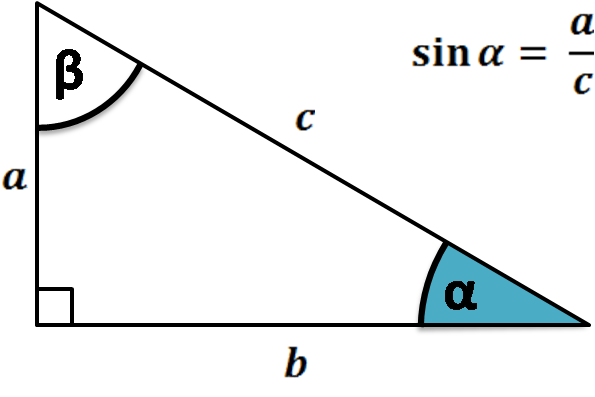
Sine is one of the three most common (others are cosine and tangent, as well as secant, cosecant, and cotangent). The abbreviation of sine is sin e.g. sin(30°)sin(30°). The most common and well-known sine definition is based on the right-angled triangle. Let's start with the nomenclature of triangle sides, which will be useful in further steps. As the picture on the right shows, we can name the sides of a right triangle as:
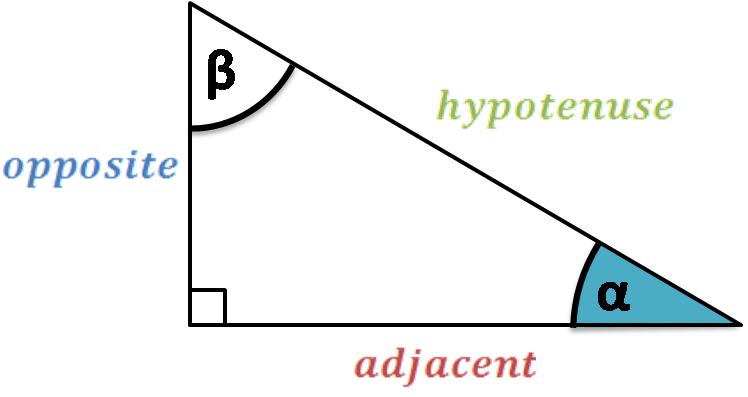
- Adjacent side – the shorter adjacent side of the angle of interest (in this case, angle αα). This side is adjacent to both the angle of interest and the right angle.
- Opposite side – merely the side opposite to the angle of interest.
- Hypotenuse – the opposite side to the right angle; it's always the longest side in the right triangle.
So if our angle of interest changes to ββ, then the adjacent and opposite sides will be exchanged – but a hypotenuse stays the same.
Did you expect to find right triangles here? Trigonometry and triangles share many characteristics: we calculate Pythagorean theorem more often when studying angles than triangles!
-
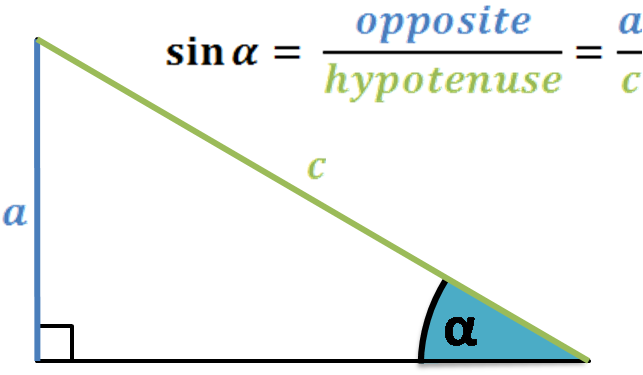
Right-angled triangle definition
The sine of an angle is the length of the opposite side divided by the length of the hypotenuse with the assumption that the angle is acute (0°<α<90°0°<α<90° or 0<α<π/20<α<π/2).
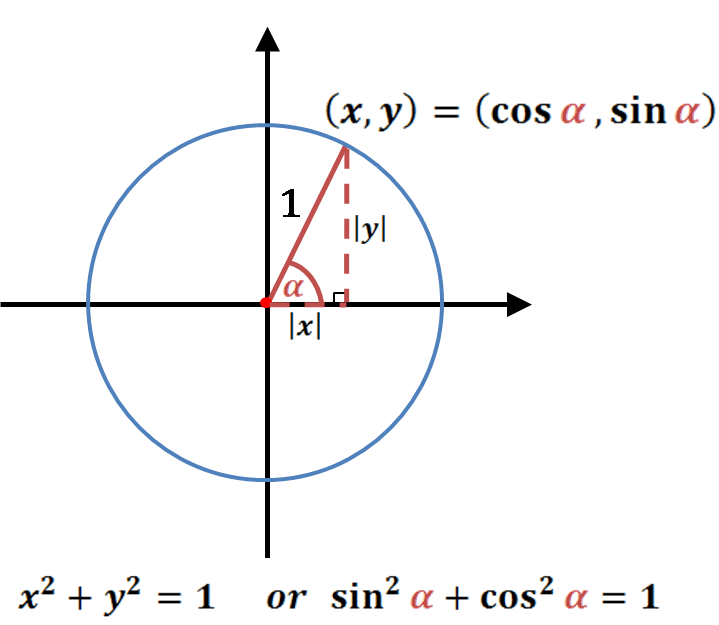
The other sine definition is based on the unit circle.
-
Unit circle
In this definition, α is any angle, and sine is a y-coordinate of the point of intersection between a unit circle and a line from the origin, making an angle of α. Sounds complicated, but if you look at the picture, everything should be clear. For a unit circle, the radius is – of course – equal to 11, so the sine is:
Look at the picture again – do you understand where the Pythagorean trigonometric identity comes from?
Other important properties of a sine function:
- Range of sine is −1≤sin(α)≤1−1≤sin(α)≤1;
- Sine period is equal to 2π2π;
- It's an odd function, which means that sin(−α)=−sin(α)sin(−α)=−sin(α); and
- Roots of the sine function: kπkπ.
💡 This is just one of our trigonometric functions calculators: discover the others at the cosine calculator and tangent calculator!
Sine curve – sine waves
The basic equation of a sine wave – sinusoid – may be expressed as:
or:
where:
- AA — Amplitude;
- ff — Ordinary frequency – the number of oscillations that occur each second of time;
- ω=2πfω=2πf – Angular frequency, in units of radians per second;
- φφ – Phase, specified (in radians) where in its cycle, the oscillation is at t=0t=0.
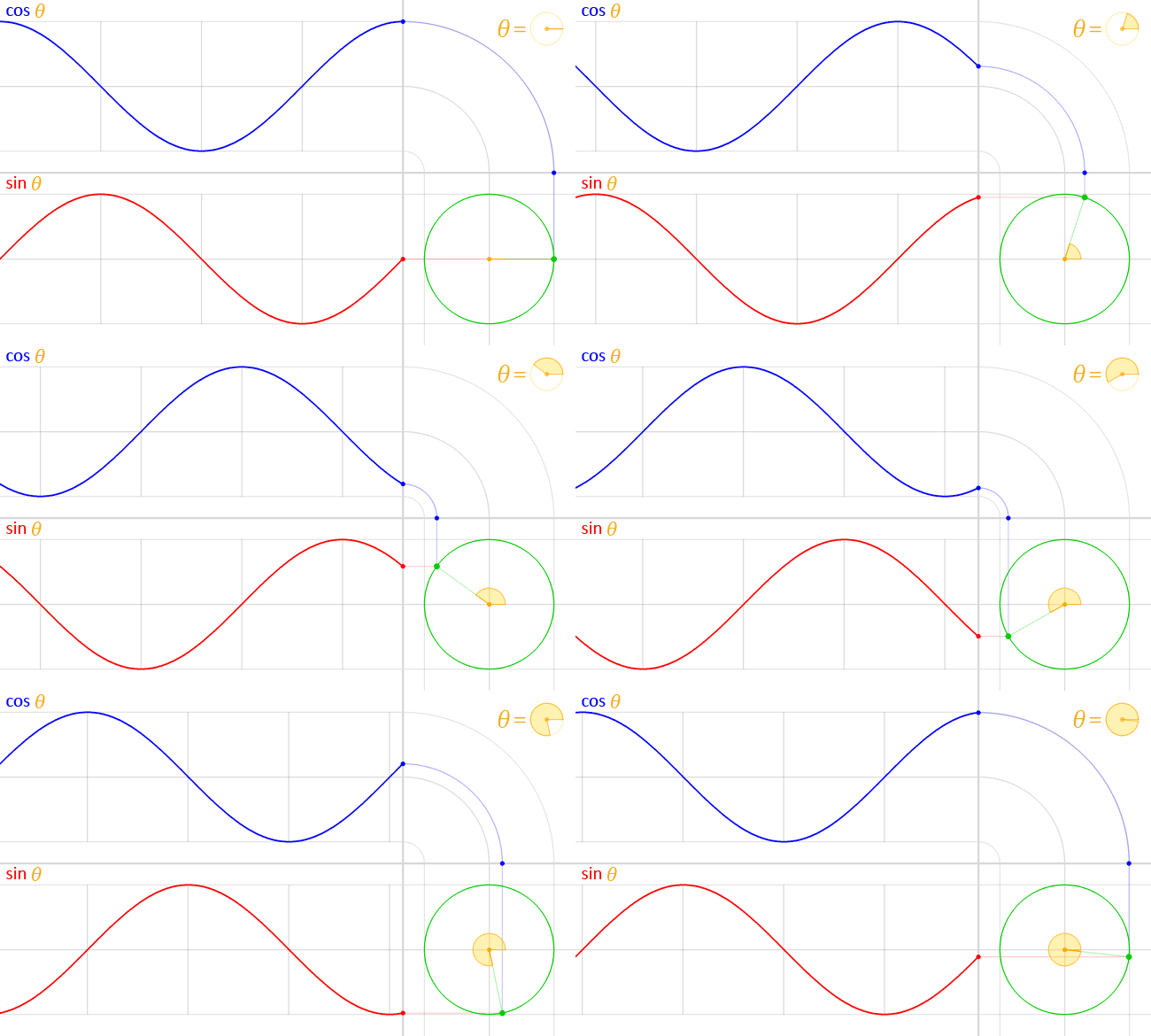
Did you notice that the graphs of the sine and cosine functions are sinusoids of different phases?

Sine waves are very useful and have applications in many different fields, such as mathematics, physics, engineering, and signal processing. But sinusoids are present all around us! Let's take, for example, wind, sound, or light waves – all these are exemplary sine waves occurring in nature.
Sine graph and table (sin 0, sin 30 degrees...)
The sine graph below shows the sinusoid in <−2π,2π><−2π,2π> range:

Exact sine value is particularly easy to remember and to define for certain angles:
αα (angle) | sin(α)sin(α) | ||
|---|---|---|---|
Degrees | Radians | Exact | Decimal |
0°0° | 00 | 00 | 00 |
15°15° | π/12π/12 | (6−2)/4(6−2)/4 | 0.25881904510.2588190451 |
30°30° | π/6π/6 | 0.50.5 | 0.50.5 |
45°45° | π/4π/4 | 2/22/2 | 0.70710678120.7071067812 |
60°60° | π/3π/3 | 3/23/2 | 0.86602540380.8660254038 |
75°75° | 5π/125π/12 | (6+2)/4(6+2)/4 | 0.96592582630.9659258263 |
90°90° | π/2π/2 | 11 | 11 |
105°105° | 7π/127π/12 | (6+2)/4(6+2)/4 | 0.96592582630.9659258263 |
120°120° | 2π/32π/3 | 3/23/2 | 0.86602540380.8660254038 |
135°135° | 3π/43π/4 | 2/22/2 | 0.70710678120.7071067812 |
150°150° | 5π/65π/6 | 0.50.5 | 0.50.5 |
165°165° | 11π/1211π/12 | (6−2)/4(6−2)/4 | 0.25881904510.2588190451 |
180°180° | ππ | 00 | 00 |
Also, you can observe how the sine function behaves according to a quadrant. For angles out of this table's range, remember the periodicity of the sine sin(α+360°)=sin(α)sin(α+360°)=sin(α).
Quadrant/Border | Degrees | Radians | Value | Sign | Monotony | Convexity |
|---|---|---|---|---|---|---|
0°0° | 00 | 00 | root, inflection | |||
1st quadrant | 0°<α<90°0°<α<90° | 0<α<π/20<α<π/2 | 0<sin(α)<10<sin(α)<1 | ++ | increasing | concave |
90°90° | π/2π/2 | 11 | maximum | |||
2nd quadrant | 90°<α<180°90°<α<180° | π/2<α<ππ/2<α<π | 0<sin(α)<10<sin(α)<1 | ++ | decreasing | concave |
180°180° | ππ | 00 | root, inflection | |||
3rd quadrant | 180°<α<270°180°<α<270° | π<α<3π/2π<α<3π/2 | −1<sin(α)<0−1<sin(α)<0 | −− | decreasing | convex |
270°270° | 3π/23π/2 | −1−1 | minimum | |||
4th quadrant | 270°<α<360°270°<α<360° | 3π/2<α<2π3π/2<α<2π | −1<sin(α)<0−1<sin(α)<0 | −− | increasing | convex |
Sine calculator – how to use
It couldn't be easier! Just:
-
Type the angle into the appropriate box. You can choose between two units – degrees and radians. Let's assume we want to find the sine of 40°40°.
-
The sin calculator shows the result immediately! It's equal to 0.64280.6428 (don't forget that's only an approximate value).
You can use the calculator the other way around as well:
-
Enter the sin value. For example, let's type 0.70.7.
-
Here we go! The sine calculator finds the angle as well! It's 44.43°44.43°. Remember that we show the angle in a <−90°,90°><−90°,90°> range – but a sine function is periodic, you can easily find other angles for which the same sine value occurs, just add or subtract multiples of 360°360° (2π2π), e.g., 0.7=sin(44.43°)=sin(404.43°)=sin(−315.57°)=...0.7=sin(44.43°)=sin(404.43°)=sin(−315.57°)=.... Don't forget about the parity - the function is odd, so sin(−α)=−sin(α)sin(−α)=−sin(α).
Now as you understand what sine is, check out more advanced applications of that function: visit our law of sines calculator to meet the sine in its most common usage, solving triangle problems.
FAQs
- What does the Sine Calculator do?
- Use our sin calculator to find out the sine value for chosen angle. Use the calculator above for instant results in your browser.
- Is the Sine Calculator free to use?
- Yes. All Try To Calculator tools are free and do not require an account.
- Are my inputs stored or sent to a server?
- No. Calculations run locally in your browser. We do not collect the numbers you enter or the results shown.
- Can I use the Sine Calculator for professional decisions?
- This tool is for education and quick estimates. For medical, legal, tax, or financial decisions, verify results with a qualified professional.
- Where can I find related calculators?
- Browse more Math tools on Try To Calculator at /math, or use the related calculators section on this page.
Related calculators
Remainder
Use the remainder calculator to find the quotient and remainder of division.
Math
Slope
Calculate the slope of a line from two given points using the slope calculator. Discover the slope formula and learn how to find a slope with two points.
Math
Average
Calculate the average (mean) with our user-friendly tool. Discover how to find averages or perform quick calculations effortlessly.
Math
Circumference
Use this free circumference calculator to find the area, circumference and diameter of a circle.
Math