
Supplementary Angles Calculator
Welcome to the supplementary angle calculator. You don't need to rack your brain on how to find supplementary angles anymore - read our supplementary angles definition or simply click through our tool, and everything should be clear! Apart from knowing what is the supplementary angle, this calculator will allow you to quickly check if two angles are supplementary.
Don't forget to check out the twin brother of this calculator - the complementary angles calculator.
What are supplementary angles? Supplementary angles definition
The adjective supplementary describes a special relationship between two angles. Specifically, according to a supplementary angles definition, these two angles sum up to 180° (or π if you're using radians).
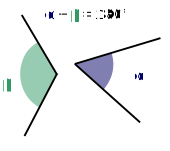
In other words, if they were adjacent, then they'd form a straight line.
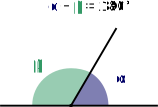
Also, keep in mind the essential properties of supplementary angles:
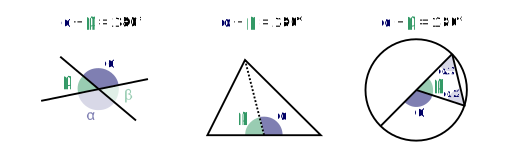
- Only two angles that sum up to 180° (π) are supplementary. Three (or more) can - of course - sum up to that value (that happens in the triangle angle calculator), but they're not supplementary angles.
- Your two supplementary angles cannot be both obtuse or both acute - there are only two options:
- One angle is acute, and the other is obtuse.
- Both of them are right angles.
How to find supplementary angles?
Let's consider two probable scenarios - you're searching for a supplementary angle to your given angle, or you have two angles, and you wonder if they are supplementary. You can solve both questions with this supplementary angles calculator:
-
1st scenario: What is the supplementary angle?
Subtract your given angle from 180°:
supplementary angle = 180° - angle, or in π rad:
supplementary angle = π - angle -
2nd scenario: Are these two angles supplementary?
Check if their sum equals 180°:
angle1 + angle2 = 180° (π)- the angles are complementaryangle1 + angle2 ≠ 180° (π)- the angles are not complementary
So, for example, are these two angles supplementary?
- 30° and 150° are supplementary (as they add up to 180°)
- 2π/3 and π/3 are supplementary (as they sum up to π)
- but 60° and 140° are not supplementary
Check your calculations with our supplementary angles calculator!
Adjacent supplementary angles
Searching for the adjacent supplementary angles in geometry is so frequent and natural that you may not even realize you're doing so! You're using the definition of the supplementary angle every time you have two lines or line segments that intersect (linear pair), as they form pairs of adjacent angles that are supplementary:
And where can you find non-adjacent supplementary angles?
- For example, in a parallelogram - the consecutive angles are supplementary in any parallelogram.
- As a parallelogram is a special case of a rhombus, a rectangle, or even a square, the consecutive angles in these shapes are also non-adjacent supplementary angles.
- In a trapezoid, leg angles are supplementary (as the leg intersects a pair of parallel lines that contain the trapezoid's bases).
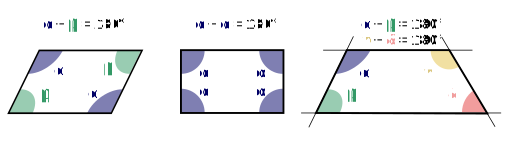
Can you think of some other examples?
Supplementary angles relationships
Knowing that two angles are supplementary is useful when you deal with trigonometric functions. Particularly, if you know that α and β are supplementary angles (α + β = 180° (π)), then you automatically will figure out that:
-
The sines of the supplementary angles are equal
sin(α) = sin(β) -
The cosine of an angle is the negative of its supplement
cos(α) = -cos(β) -
Similarly, the tangents of the supplementary angles are equal with opposed signs (unless the tangent is undefined)
tan(α) = -tan(β)
You can learn more about those functions in our trigonometric functions calculator.
FAQs
- What does the Supplementary Angles Calculator do?
- Easily calculate supplementary angles or check if two angles are supplementary with our intuitive tool. Use the calculator above for instant results in your browser.
- Is the Supplementary Angles Calculator free to use?
- Yes. All Try To Calculator tools are free and do not require an account.
- Are my inputs stored or sent to a server?
- No. Calculations run locally in your browser. We do not collect the numbers you enter or the results shown.
- Can I use the Supplementary Angles Calculator for professional decisions?
- This tool is for education and quick estimates. For medical, legal, tax, or financial decisions, verify results with a qualified professional.
- Where can I find related calculators?
- Browse more Math tools on Try To Calculator at /math, or use the related calculators section on this page.
Related calculators
Remainder
Use the remainder calculator to find the quotient and remainder of division.
Math
Slope
Calculate the slope of a line from two given points using the slope calculator. Discover the slope formula and learn how to find a slope with two points.
Math
Average
Calculate the average (mean) with our user-friendly tool. Discover how to find averages or perform quick calculations effortlessly.
Math
Circumference
Use this free circumference calculator to find the area, circumference and diameter of a circle.
Math