
Piston Force Calculator
The piston force calculator estimates the force on a piston cylinder system based on the given piston head diameter and cylinder pressure. The piston is a crucial part of any hydraulic or pneumatic machine, as well as engines. It is important to get the right estimate of the forces acting on an engine piston for any preliminary design study. The force and pressure in a piston cylinder system are used to decide the cylinder diameter and area i.e. the size of a cylinder. This is ultimately useful when estimating the size of a machine, be it an engine or a hydraulic or pneumatic cylinder. This calculator also helps you find out the piston force or the cylinder pressure, enabling you to move onto the next stage of your design study.
What is a piston and piston force?
A piston is a circular disk-shaped component that transfers hydraulic or pneumatic force from expanding gases inside a cylinder to a crankshaft using a connecting rod, or vice versa. Pistons were initially used in steam engines and radial engines, driving the trains and aircraft of the 20th century. One can also apply the working principle of the piston and cylinder setup to make pumps.
The force exerted on the piston under the cylinder pressure is known as the piston force or piston cylinder force. An example of such force is found in a hydraulic system: we explored the generic working principle of such systems at our hydraulic pressure calculator. To find such a force you need the cylinder force equation, which can be found below.
Piston force equation
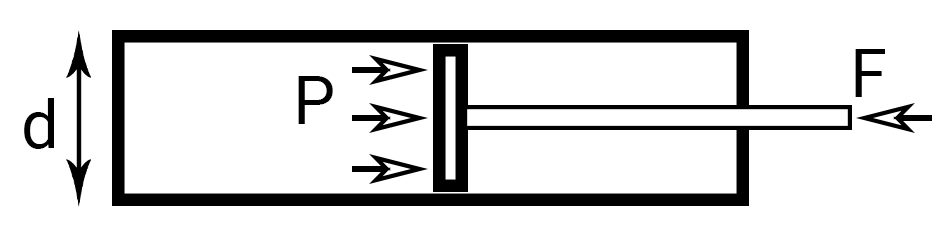
The piston force relationship is given below:
where:
- FF – Piston force;
- AA – Bore area; and
- PP – Cylinder pressure.
The bore area can be found by:
where:
- dd – Piston's diameter.
Alternatively, the piston force, FF, can be written mathematically as:
How to use the piston force calculator?
Before you use the piston force calculator, you need to measure or estimate the bore diameter. Once you have an estimate:
- Enter the bore diameter dd to estimate the area.
- Enter the cylinder pressure.
- The calculator will provide the piston force, FF.
Alternatively, you can also enter the bore area and the desired force value to determine the piston's size or calculate cylinder pressure.
Example: Using the piston force calculator.
Let's say we have an engine with a cylinder bore diameter of 25 mm25 mm and a piston pressure of 100 kPa100 kPa. How much force is exerted on the piston?
Given, d=25 mm=0.025 md=25 mm=0.025 m and P=100 kPaP=100 kPa:
Calculating piston cylinder force from pressure:
-
Enter the piston pressure, P=100 kPaP=100 kPa.
-
The calculator returns the force acting on an engine piston in this case, which is:
Therefore, the force on piston for a given cylinder pressure is calculated as 49.09 N49.09 N.
Cylinder pressure to piston cylinder force equation
Alternatively, if you have a known force acting on an engine piston, FF, say 500 N500 N, and wish to estimate the piston pressure over a 25 mm25 mm bore cylinder. You can enter:
Piston diameter, d=25 mm=0.025 md=25 mm=0.025 m and force, F=500 NF=500 N:
Hence, the piston pressure equals 1018.9 kPa1018.9 kPa for the given force of 500 N500 N.
So, you can either use this tool as a cylinder pressure to piston cylinder force calculator or to use piston force to calculate cylinder pressure.
🙋 For other piston-related tools, visit our pneumatic cylinder force calculator and our piston speed calculator!
Pistons in action
Pistons in an engine
The piston moves along the longitudinal axis of a cylinder transmitting power to the crankshaft, while converting the reciprocating motion into rotary motion and vice versa. For a diesel or petrol engine, the air-fuel mixture gets compressed in the cylinder at the compatible compression ratio.
Each engine can have several pistons, usually in a V-shaped row, which is how some engines (V8 and V12) get their names. This type of engine can be used in either automobile, aircraft, and ships. One such V12 engine, Rolls Royce's Merlin, ran two of World War II's most iconic aircrafts, the Spitfire and the Hurricane. A more recent example is the V10 engine that powers the Audi R8 to a top speed of over 200 miles per hour. Piston engines are also used to power motorboats. If you would like to know how to calculate the speed of your car or boat, head over to our speed calculator.
Piston pump
We can also see pistons in action in pumps. The piston moves up and down the pump cylinder to create pressure which moves the liquids or gases at a desired flow rate.
Hydraulic systems
Pistons are also a vital part of hydraulic and pneumatic systems used to lift loads and for actuation purposes such as extending or lowering an aircraft's landing gear. Be it your regular passenger flight, like the Airbus A330/340 or Boeing 787 passenger aircraft, or military aircraft, like the C-130J "Hercules", MiG 23 "Flogger" or an F22 "Raptor", the hydraulic systems help actuate the aircraft's control surfaces such as flaps, aileron, and elevators, helping the pilot navigate the skies.
Hydraulics are also found in heavy earth-moving machinery, like a JCB, crane, or excavator, where a piston-cylinder system is used for the actuation of the arm which moves heavy loads.
That's right! All this technology begins with simple load and dimensions calculations in piston-cylinder systems.
FAQs
- What does the Piston Force Calculator do?
- Calculate the force in a cylindrical piston from the pressure applied. Use the calculator above for instant results in your browser.
- Is the Piston Force Calculator free to use?
- Yes. All Try To Calculator tools are free and do not require an account.
- Are my inputs stored or sent to a server?
- No. Calculations run locally in your browser. We do not collect the numbers you enter or the results shown.
- Can I use the Piston Force Calculator for professional decisions?
- This tool is for education and quick estimates. For medical, legal, tax, or financial decisions, verify results with a qualified professional.
- Where can I find related calculators?
- Browse more Physics tools on Try To Calculator at /physics, or use the related calculators section on this page.
Related calculators
Acceleration
The acceleration calculator estimates acceleration using three different approaches – velocity difference, distance traveled over time, and net force vs. mass.
Physics
Density
Use the density calculator to instantly find how tightly packed an object's molecules are.
Physics
Free fall
Our free fall calculator can find the velocity of a falling object and the height it drops from.
Physics
Projectile motion
Use our projectile motion calculator to analyze a projectile in parabolic motion.
Physics