
Rayleigh Distribution Calculator
Welcome to the Rayleigh distribution calculator! With its help, you can quickly compute a bunch of things related to the Rayleigh distribution. Do you need to find some probabilities, determine some pdf / cdf / quantile values, or just compute the mean and variance of the Rayleigh distribution? Our Rayleigh distribution calculator can do all of this and even more: it can also draw samples from the Rayleigh distribution!
What is the Rayleigh distribution? To learn more about the Rayleigh distribution function, scroll down! Apart from the Rayleigh distribution definition, we provide formulas for the Rayleigh distribution mean, variance, and other measures!
What is the Rayleigh distribution?
The Rayleigh distribution is a continuous probability distribution. It owes its name to the English Lord Rayleigh (John William Strutt, 3rd Baron Rayleigh), who encountered this distribution when working on problems in acoustics.
The Rayleigh distribution is a special case of the Weibull distribution. Therefore, whatever you know about the Weibull distribution applies to the Rayleigh distribution.
Recall that the well-known exponential distribution is also a special case of the Weibull distribution. It turns out that the Rayleigh and exponential distributions are tightly linked: the square root of an exponential random variable is a Rayleigh random variable.
A natural situation where you can encounter the Rayleigh distribution function is when you take two independent random variables, X and Y, that follows the normal distribution with a mean of zero and equal standard deviations. Then the random variable √(X² + Y²) follows the Rayleigh distribution. Please check out our normal distribution calculator.
As we now know what the Rayleigh distribution is, it is time to explain how you can use our Rayleigh calculator. In the following sections, you will find the definition of the Rayleigh distribution and a bunch of formulas related to it, including that of the Rayleigh cumulative distribution function (cdf of Rayleigh distribution) and the Rayleigh probability density function (pdf of Rayleigh distribution).
How to use this Rayleigh calculator?
To use the Rayleigh calculator, follow the instruction below:
-
Choose the calculator mode. Our Rayleigh distribution calculator has several modes. Thanks to them, you can very quickly generate samples from the Rayleigh distribution or determine:
- Probabilities;
- Values of the cumulative distribution function;
- Values of the probability density function;
- Values of the quantile function; and
- Common measures of the Rayleigh distribution.
In particular, if you want to find the mean and variance of the Rayleigh distribution, you should use the
common measures mode. -
For each Rayleigh distribution function, enter the value of the parameter you want to use in the calculations.
-
Depending on the mode you've chosen, provide any additional input. For instance, for the
cdf modeyou need to enter the argumentxat which you want to evaluate the Rayleigh cdf. -
That's all! The Rayleigh distribution calculator displays the result immediately!
Rayleigh distribution function and definition
The probability density function (pdf) of the Rayleigh distribution reads:

where σ > 0 is a parameter. Let's see what the pdf of the Rayleigh distribution looks like for different Rayleigh distribution examples with various values of σ:
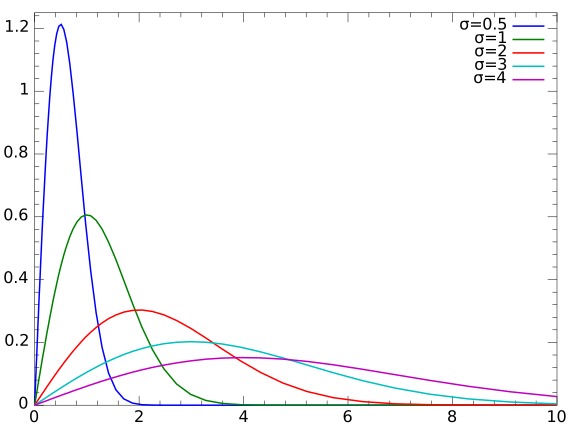
The cumulative distribution function (cdf) of the Rayleigh distribution is the following:

Here you can see what the cdf of the Rayleigh distribution looks like for different Rayleigh distribution examples with various σ:
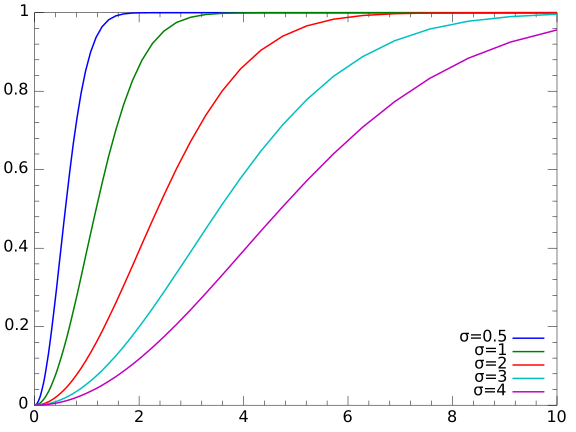
We can easily derive the quantile function (i.e., the inverse of the cdf) of the Rayleigh distribution. It's given by the following formula:

Variance and mean of the Rayleigh distribution (and other measures)
This section provides the formulae for the common measures of the Rayleigh distribution: its mean, median, mode, variance, and skewness.
-
Mean of the Rayleigh distribution:
σ × √(π / 2) -
Median of the Rayleigh distribution:
σ × √(2 ⋅ ln(2)) -
Mode of the Rayleigh distribution:
σ -
Variance of the Rayleigh distribution:
σ² × (4 - π)/2Obviously, the standard deviation of the Rayleigh distribution is just the square root of the Rayleigh variance.
-
Skewness of the Rayleigh distribution:
2 × (π - 3) × √(π / (4 - π)³)
Please check out our median calculator, mode calculator, variance calculator and skewness calculator to understand more on this topic.
Applications of the Rayleigh distribution — Rayleigh distribution examples
The Rayleigh distribution appears repeatedly in mathematical modeling. For instance, you can encounter it in:
- Electrical engineering — to model the lifetime of resistors, capacitors and transformers;
- Physics — to model sound or light radiation;
- Weather forecasting — to model wind speed; AND
- Hydrology — to model wave heights
FAQs
- What does the Rayleigh Distribution Calculator do?
- Our Rayleigh distribution calculator helps you generate samples from the Rayleigh distribution, or determine probabilities, cdf, pdf, quantiles, and common measures in this distribution. Use the calculator above for instant results in your browser.
- Is the Rayleigh Distribution Calculator free to use?
- Yes. All Try To Calculator tools are free and do not require an account.
- Are my inputs stored or sent to a server?
- No. Calculations run locally in your browser. We do not collect the numbers you enter or the results shown.
- Can I use the Rayleigh Distribution Calculator for professional decisions?
- This tool is for education and quick estimates. For medical, legal, tax, or financial decisions, verify results with a qualified professional.
- Where can I find related calculators?
- Browse more Statistics tools on Try To Calculator at /statistics, or use the related calculators section on this page.
Related calculators
5★ rating average
The rating average calculator returns an average rating based on the number of 1-5 ratings.
Statistics
Dice probability
With this dice probability calculator, you can easily find the various probabilities related to rolling a set of dice.
Statistics
Critical value
The critical value calculator helps you find the one- and two-tailed critical values for the most widespread statistical tests.
Statistics
Coin flip probability
Coin flip probability calculator lets you calculate the likelihood of obtaining a set number of heads when flipping a coin multiple times.
Statistics