
Weibull Distribution Calculator
Welcome to the Weibull distribution calculator! Here you can quickly generate samples, determine probabilities, and find the values of the pdf, cdf, and quantile functions of the Weibull distribution.
Are you not sure what the Weibull distribution is? Do you want to know how to calculate the Weibull distribution? Then keep reading! We will explain to you what the Weibull distribution parameters mean and provide you with a few Weibull distribution formulas. As a bonus, we will also show you how to calculate the mean of the Weibull distribution, as well as its median, mode, variance, and skewness.
What is the Weibull distribution?
The Weibull distribution is a continuous probability distribution. It is very versatile, which is why it is widely used in mathematical modeling. You can find Weibull distribution examples in:
- Survival analysis;
- Electrica engineering;
- Reliability engineering and failure analysis; and
- Hydrology and weather forecasting.
The importance of the Weibull distribution comes from the fact that it can assume different shapes. The available shapes vary from an exponential distribution through to a nearly symmetric bell-shaped distribution to even a right-skewed distribution. A particular case of the Weibull distribution is the Rayleigh distribution. You can learn more about them in our dedicated tools:
The next section provides details about the Weibull distribution formula.
💡 The Weibull distribution owes its name to a Swedish mathematician Waloddi Weibull, who described it in 1951. However, Maurice Fréchet studied this distribution more than twenty years earlier (in 1927).
Weibull distribution formula. Weibull distribution examples
So, how to calculate the Weibull distribution? Let's firstly look at its probability density function (pdf):
where:
λ > 0is the scale parameter; andk > 0is the shape parameter.
The scale parameter, λ, is responsible for stretching/squeezing the distribution along the horizontal axis. If λ is large, then the distribution is more spread out. If λ is small, then the distribution is more concentrated.
Thanks to the presence of the shape parameter, k, the Weibull distribution can take on different shapes. The below Weibull distribution examples shows how the pdf of the Weibull distribution changes as we vary the value of k:
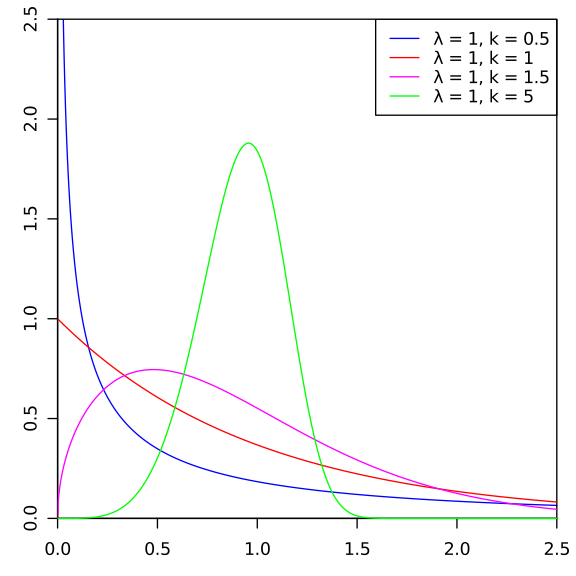
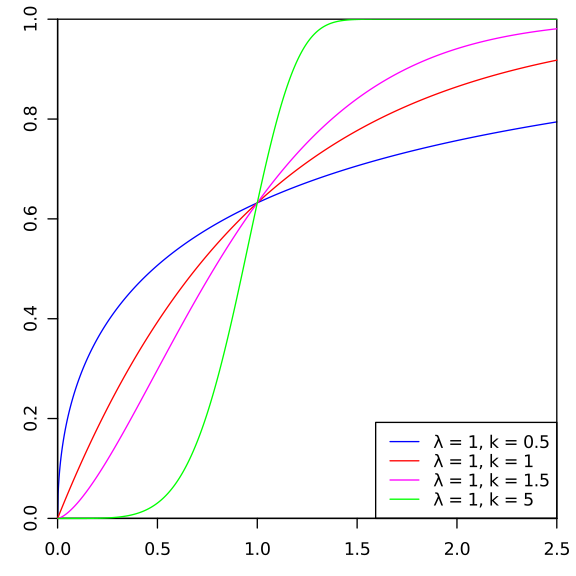
In the second plot you can see how the cumulative distribution function of the Weibull distribution (Weibull cdf) changes with the value of k:
How to calculate the Weibull distribution?
There are several different things related to the Weibull distribution that you may want to calculate. Let's go through them one by one.
-
How to calculate probabilities in the Weibull distribution:
Let
Fstand for the cumulative distribution function of the Weibull distribution (Weibull cdf). The formula for the Weibull cdf is the following:
By the very definition of the cdf, we have
P(X ≤ x) = F(x)
As we deal with a continuous probability distribution, we have
P(X < x) = F(x)
and
P(X ≥ x) = P(X > x) = 1 - F(x).
- How to calculate quantiles in the Weibull distribution?
The quantile function of the Weibull distribution reads:
where 0 ≤ p <1 Recall that the quantile function is the inverse of the cdf.
-
How to draw a sample from the Weibull distribution?
It's easy to sample from the Weibull distribution, provided you can sample from the uniform distribution on
(0,1).Namely, if
Xis a random variable following the uniform distribution on(0,1), then the random variable λ(−lnX)1/kλ(−lnX)1/k follows the Weibull distribution with scale parameterλand shape parameterk.
Common measures of the Weibull distribution
In this section, we give the formulas of the most common measures of central tendency (mode, median, and mean of the Weibull distribution), of spread (standard deviation and variance of the Weibull distribution), and of shape (skewness of the Weibull distribution).
- Mean of the Weibull distribution:
- Median of the Weibull distribution:
- Mode of the Weibull distribution:
- Variance of the Weibull distribution:
As you surely remember, the standard deviation of the Weibull distribution is just the square root of the Weibull variance.
- Skewness of the Weibull distribution:
Interestingly, in the Weibull distribution the skewness depends only on the shape parameter k.
🙋 If you're not yet familiar with the statistical notion of skewness, check out our skewness calculator.
How to use this Weibull calculator?
Below, you can find an instruction about using the Weibull calculator:
-
Choose the calculator mode. Our Weibull distribution calculator has six modes, which allow you to determine:
- Probabilities;
- Samples (of any length!);
- Values of cdf;
- Values of pdf;
- Quantiles; and
- A few of the most common distribution measures.
-
Enter the parameters of the Weibull distribution you want to work with.
-
You may need to enter more required data. For instance, for the
sample generator modeenter the length of the sample, and for thepdf modeenter the argumentxat which the Weibull pdf will be evaluated. -
Our Weibull distribution calculator returns the result in a blink of an eye! Enjoy! 😊
FAQs
- What does the Weibull Distribution Calculator do?
- Use this Weibull distribution calculator if you need find probabilities, quantiles, etc. in the Weibull distribution, or generate samples from this distribution. Use the calculator above for instant results in your browser.
- Is the Weibull Distribution Calculator free to use?
- Yes. All Try To Calculator tools are free and do not require an account.
- Are my inputs stored or sent to a server?
- No. Calculations run locally in your browser. We do not collect the numbers you enter or the results shown.
- Can I use the Weibull Distribution Calculator for professional decisions?
- This tool is for education and quick estimates. For medical, legal, tax, or financial decisions, verify results with a qualified professional.
- Where can I find related calculators?
- Browse more Statistics tools on Try To Calculator at /statistics, or use the related calculators section on this page.
Related calculators
5★ rating average
The rating average calculator returns an average rating based on the number of 1-5 ratings.
Statistics
Dice probability
With this dice probability calculator, you can easily find the various probabilities related to rolling a set of dice.
Statistics
Critical value
The critical value calculator helps you find the one- and two-tailed critical values for the most widespread statistical tests.
Statistics
Coin flip probability
Coin flip probability calculator lets you calculate the likelihood of obtaining a set number of heads when flipping a coin multiple times.
Statistics